Friday, 3 October 2025
Shrinking Springtails

Wednesday, 16 July 2025
Entomobrya petri
McCulloch, J.I. (2025) Entomobrya petri sp. nov.: A new species of springtail found in the British Isles. Soil Organisms 97 (2). https://doi.org/10.25674/476
"A new species of elongate springtail (Collembola: Entomobryomorpha) is described from a churchyard in Edinburgh: Entomobrya petri sp. nov. Microscopic examination of specimens from another site in the UK supports that this new species represents the taxon previously referred to as "Entomobrya nr. imitabilis", which is widespread in the British Isles. As well as that of the examined specimens, the ecology and distribution of the morphospecies generally is discussed."
Monday, 21 April 2025
Springtails on NBN
Thanks to the hard work of James McCulloch & Duerden Cormack more than 6,000 springtail records have been imported from iRecord and are now available on the NBN Atlas, bringing the total number of records online to over 26,000. This is a major milestone for springtail recording and will stimulate further records.
Sunday, 16 February 2025
Another instance of DNA not helping
Friday, 24 January 2025
Finally some good news
2024 was a very sad year when we lost some major figures in the springtail community. Frans Janssens was an enormous help to me when I started recording springtails and I was sad to hear of his passing. I also learned so much from Peter Shaw that I felt this additional loss keenly. Fortunately, 2025 begins on a brighter note with the news that James McCulloch has taken over the UK Springtail Recording Scheme. James is a highly knowledgeable springtail enthusiast, and even better, has already started verifying springtail records submitted via iRecord, a daunting task which has not happened before. All this is very positive for the future and I am encouraged by this positive development.
Sunday, 2 October 2022
Sminthurides malmgreni
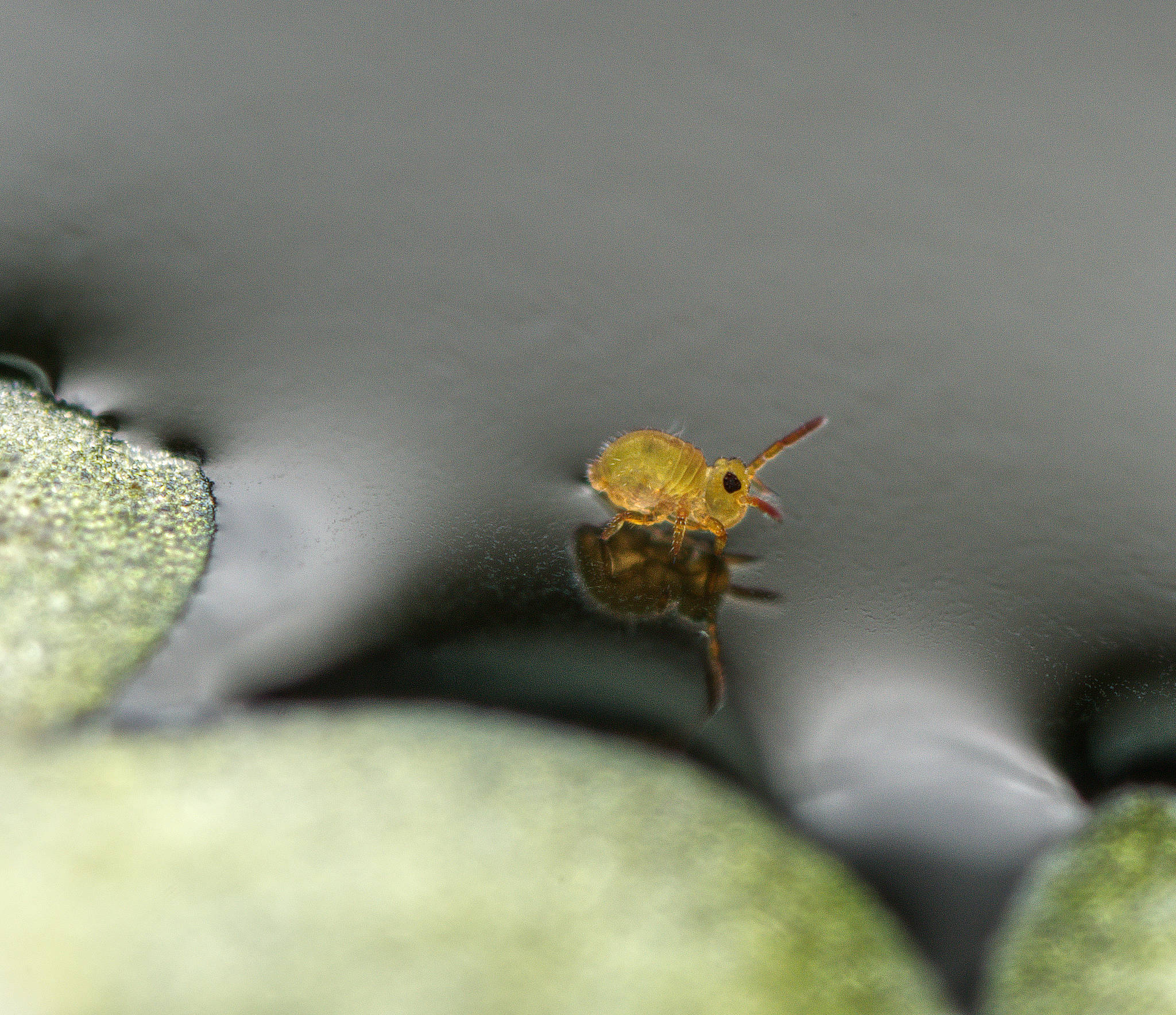
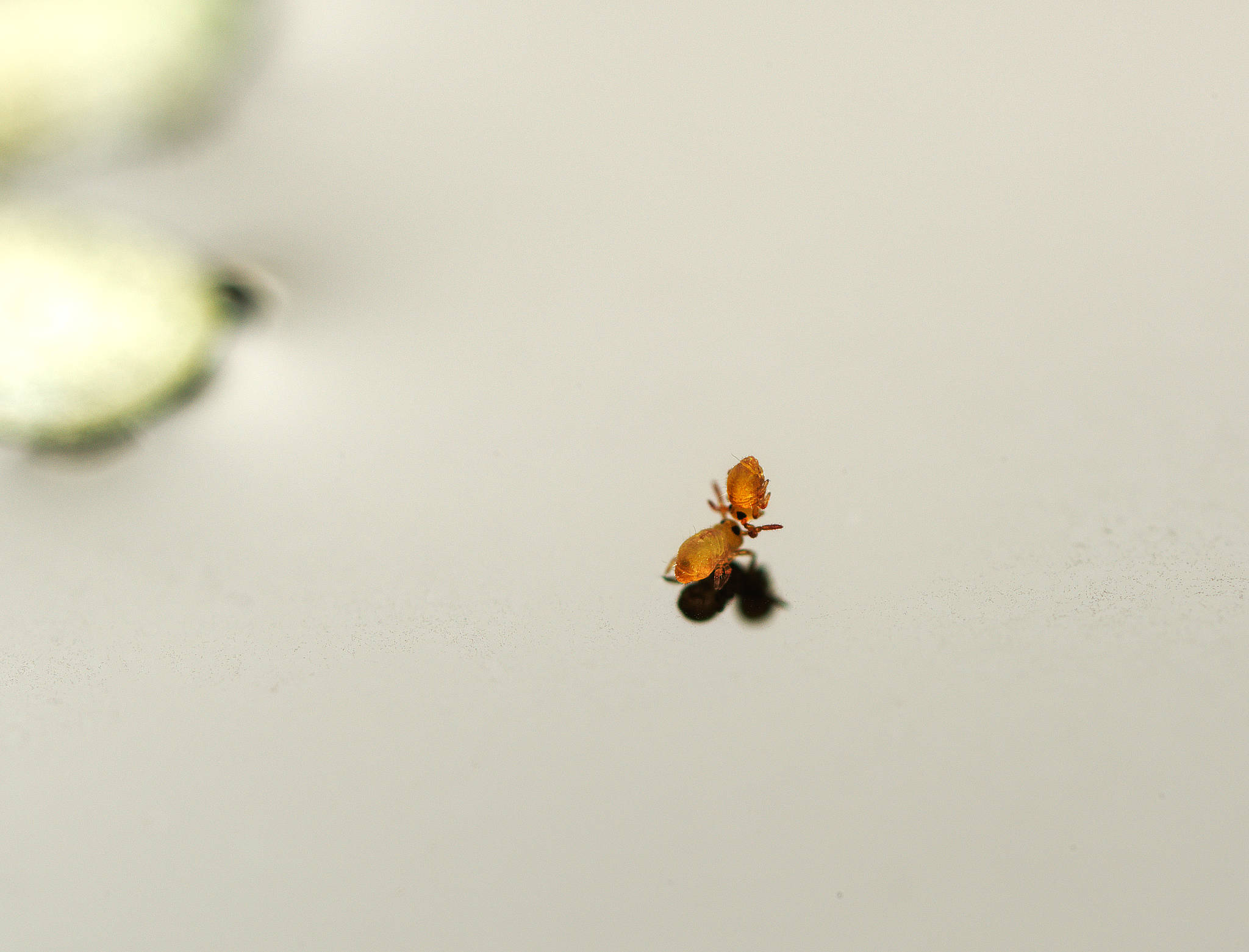
For the past ten years the aquarium housing my ancient Axolotl has also been home to a colony of Sminthurides malmgreni. I have done nothing to maintain them, but they happily persist wandering around on the surface of the water, on and off the 1.5mm long leaves of the Common Duckweed, Lemna minor.
Inevitably on Springwatch, someone gets shipped off to Scotland to be eaten alive by midges and film the Red Deer stags locking antlers during the rut. If I want to watch rutting, I have no need to move further than the corner of my study, where the emancipated females lift the smaller males off their feet and wander off with them whenever they feel the urge.
Friday, 24 September 2021
Thursday, 3 December 2020
Into the darkness
I've been playing with darkfield microscopy - poor man's phase contrast. Darkfield uses obliqe illumination as a cheap optical trick to increase the contrast of transparent and traslucent specimens. It can produce dramatic images with dark backgrounds and usually features prominently in microscope photography competitions such as Nikon's Small Worlds. I started out with the somewhat translucent furca of a handy Isotomurus unifasciatus specimen. On the left is my conventional setup of top plus bottom illumination, post processed; on the right darkfield transillumination, both stacked with Zerene:
Thursday, 4 June 2020
Sminthurus viridis ssp. cinereoviridis
I have to admit that springtails have been on the back burner recently while I've been focusing mostly on spiders. The weather hasn't helped but it's not an excuse, mostly I've been working on spiders. I have been recording springtails regularly, but I haven't posted anything publicly because I haven't found anything particularly interesting - until today. This morning the vacuum sampler turned up a whole bunch of these. After some rusty fumbling, they keyed out to be Sminthurus viridis (which I have found several times recently), but specifically Sminthurus viridis ssp. cinereoviridis (thanks to Frans Janssens for help with the I.D.).
Sminthurus viridis ssp. cinereoviridis has 2 spots on small abdomen. In the ecovariant nigromaculatus of S. viridis, 3 spots are present: https://www.collembola.org/images/stach/1956/Sminthurus-viridis-1956-J-Stach-Poland-PlateXXXII-Fig3.jpg There are supposedly difference in chaetotaxy of the setae on the subcoxa of the third leg, but I have found it impossible to image these. Steve Hopkins was reluctant to accept nigromaculatus as a separate species. As a dyed-in-the-wool taxonomic lumper, I wouldn't disagree. Frans Janssens calls it "Sminthurus viridis (ecovariant nigromaculatus)", which is said to be associated with sandy areas, heathland, moors, heather, etc. My specimens came from the wettest of wet water meadows alongside the River Soar and have 2 abdominal spots, so Sminthurus viridis ssp. cinereoviridis it is.
Thursday, 30 April 2020
Saturday, 14 March 2020
A cautionary tale
For those who think they can tell Isotoma viridis from other Isotoma by the colour alone - two Isotoma viridis specimens from the same sample, one green, one not, confirmed by the manubrial teeth.
Wednesday, 5 February 2020
Some like it wet
I recently bought myself a G-vac - for the uninitiated, a cordless garden leaf vacuum adapted for use as a bug vac - and I took it for its second outing this morning. How do you convert a leaf vacuum to a bug vac? Well essentially you tape a net bag over the mouth of the inlet tube. On a recommendation from a more experienced bug-vaccer I bought a nylon jam strainer bag to use for this (others use net curtain material). Now I will admit that the primary reason I bought the bug-vac was for spider work, and I wan't at all sure the jam strainer bag would retain insects as small as springtails, but on its first outing a couple of days ago I was delighted to find it worked with large spiders all the way down to springtails, including the little ones such as Lepidocyrtus.
A week or so ago, pre-vac, I had done some sampling in wet meadows beside the River Soar. At that time I'd spotted a patch of Juncus sitting in a damp hollow that looked interesting but I didn't have time to go there on my first visit. This morning I decided to go back and take a look, this time armed with the bug-vac. Bearing in mind this is a piece of electrical equipment, albeit double insulated to EU standards and designed to suck up wet leaves, I'm pretty cautious about mixing electricity and water because the 36V battery in the bug-vac could give out quite a jolt. I was therefore a bit alarmed that the bug-vac started spitting water out of the inlet when I stuck it in the Juncus, but the point of all this dicing with death is that the bug-vac turned up (alongside more run of the mill species) my first ever Isotomurus plumosus in VC55. I'm delighted but I won't be pushing my luck too far.
Wednesday, 4 December 2019
Benchmarking Springtail Recording
Heatmaps are pretty but inevitably focus attention on where the data is, rather than where it is missing. As an attempt to try to switch the emphasis I have used quadrat mapping - arbitrarily dividing VC55 into a grid and looking at the number of records within each section. A 25x25 grid worked but the the intervals were a bit small and a 10x10 grid is more informative (all VC55 Collembola records to end 2018):

The grid for Orchesella cincta looks like this:

To make sense of this, I converted the distributions into histograms:
These look pretty similar, but to be sure, I ran some further analysis:

There's a good correlation between the Orchesella cincta distribution and the overall Collembola dataset, and this is statistically significant (p = 2.2e-16). Thus Orchesella cincta is a good benchmark for springtail recording effort (at least in VC55). Phew!
Acknowledgements:
All data Copyright Leicestershire and Rutland Environmental Records Centre.
Data visualization performed using the R platform, v. 3.6.1 (R Core Team (2014) R: A language and environment for statistical computing. R Foundation for Statistical Computing, Vienna, Austria. http://www.R-project.org).
J. Cann for assistance with data visualization.
Tuesday, 26 November 2019
Springtails hitching rides on social insects

Fossil amber reveals springtails longstanding dispersal by social insects. (2019) BMC Evol Biol 19, 213 https://doi.org/10.1186/s12862-019-1529-6
Springtails (Collembola) are reported since the Lower Devonian and are thought to have originally been subterranean. The order Symphypleona is known since the early Cretaceous with genera distributed on every continent. This implies an ability to disperse over oceans, however symphypleonan Collembola have never been reported in marine water contrary to other springtail orders. Despite being highly widespread, modern springtails are rarely reported in any kind of biotic association. Interestingly, the fossil record has provided occasional occurrences of Symphypleona attached by the antennae onto the bodies of larger arthropods. Here we document the case of a ~ 16 Ma old fossil association: a winged termite and ant displaying not some, but 25 springtails attached or in close proximity to the body. By comparing the general constraints applying to the other wingless soil-dwelling arthropods known to disperse through phoresy, we suggest biases in the collection and observation of phoretic Symphypleona related to their reflexive detachment and infer that this behaviour continues today. The specific case of tree resin entrapment represents the (so far) only condition uncovering the phoretic dispersal mechanism of springtails - one of the oldest terrestrial arthropod lineages living today.
Monday, 11 November 2019
Isotoma viridis

In spite of all the rain and good numbers of springtails over the last few weeks (dominated by Dicyrtomina saundersi), Isotomids have been largely missing. However, the recent haul of leaf litter had good number of Isotoma viridis, a species I have not seen since last winter.

Wednesday, 16 October 2019
Return of some old friends

The springtails like the rain. I quite like the rain too, but maybe not this much. With the change in the season the springtails have changed. Some time ago I adopted Orchesella cincta as my index species for recording effort, on the basis that it is the commonest species in lowland Britain. Thus, when you don't see one specimen for six months, you begin to doubt. But now the season has changed they're back, and they're everywhere, and along with them are some old friends I haven't seen for a few months, Emtomobrya albocincta and E. multifasciata.
Saturday, 5 October 2019
Springs Can Only Get Better

Monobella grassei.
I've got to admit not putting too much effort into springtail recording recently. Partly this is a hangover from the summer and partly it's because I've been busy with other things, but I do regularly record springtails when I'm out and recently it's become clear that what I think of as the "winter species" are here. Foremost among these is one of my favourites, Monobella grassei, which i've found several times recently.
I can't wait for the leaf litter season to kick off.
Friday, 13 September 2019
Recent Unusual UK Collembola Records

An update of the UK list which features two particularly notable additions. The first of these is Entomobrya intermedia, an extremely common species but not one which was not recognised by Steve Hopkin. Since we know know that it stands up under DNA, it has been formally added to the list. The other is the globally invasive Desoria trispinata, a species I have not yet recorded but seems to be spreading rapidly and needs to be on our radar.
Shaw, P., & Trewhella, S. (2019) Recent Unusual UK Collembola Records – Entomobryomorpha and Poduromorpha. British Journal of Entomology and Natural History, 32 (3) 217-230. https://pure.roehampton.ac.uk/portal/files/1192939/BJENH_Shaw19.pdf
Abstract: We report substantial updates to our understanding of the distribution of nine species of UK Collembola (orders Entomobryomorpha and Poduromorpha). We note four species omitted from the main UK key (one very common) and we note the rediscovery of five species in the UK after >50 years. Three of these were previously only collected in the UK by Richard Bagnall in the 1930s.
Thursday, 5 September 2019
Progress on the VC55 Springtail Atlas

click for larger image
This is encouraging because although there are a few other people sporadically recording springtails in VC55, I have specifically targeted most of my efforts this year at extending the geographical coverage into new areas. This is particularly important because so much biological recording defaults to the regular honeypots. It is easy to see this by merging the dataset into a heatmap of observations:

click for larger image
I can make this a little more informative by breaking down the records into families and overlaying this on the heatmap:

click for larger image
The problem with this is that the data set (~600 records) just isn't large enough to say very much about the whole County, or to put it another way, the density of records is too low for good geographical coverage. In addition, there's another problem. I'm not aware of any systematic springtail recording which includes negative results, i.e. the absence of species as well as the presence. We know (anecdotally and from the heatmap) that recording effort is not equally distributed, but the limited dataset means that we simply don't have accurate geographical coverage. Resource limitations mean that there will probably never be widespread systematic recording of springtails, so my approach to this problem has been to adopt a benchmark species to infer recording effort. Orchesella cincta is said to be the most widely distributed species in lowland Britain, so I have adopted this to infer geographical coverage:

click for larger image
Thankfully (for my theory), the O. cincta data fits the heatmap pretty well, so validating this proxy for our atlas. What comes next is clearly getting off my backside and getting back out in the field :-)
Acknowledgements:
- All data Copyright Leicestershire and Rutland Environmental Records Centre.
- Data visualization performed using the R platform, v. 3.6.1 (R Core Team (2014) R: A language and environment for statistical computing. R Foundation for Statistical Computing, Vienna, Austria. http://www.R-project.org).
- J. Cann for assistance with data visualization.
Thursday, 1 August 2019
Springtails in July

Pogonognathellus longicornis
Although July is pretty much the low point in the springtail calendar, the contrast between this year and last year is stark. While we've had the hottest ever day, we've also had plenty of rain and moderate temperatures. Out and about I've been finding springtails pretty much everywhere, recording the following species at the number of sites shown:
Entomobrya nivalis: 7
Deuterosminthurus pallipes: 4
Entomobrya nicoleti: 4
Orchesella cincta: 2
Entomobrya multifasciata: 1
Isotoma viridis: 1
Pogonognathellus longicornis: 1
Tomocerus minor: 1
Springtails about, but nothing of great interest. However, this has to count as a good July for springtails.