Showing posts with label Tomocerus. Show all posts

Saturday, 31 March 2018

25.03.18: Launde Park Wood

We had planned to visit a woodland site I've never been to before, but when we got close it was clear that it simply wasn't safe to proceed - far too wet. Although we had a little rain overnight I couldn't understand why the land was so wet - until several hours later when I figured out that the snow melt of the last month has saturated the ground in the east of the county and the steep clay slopes will take several months to dry out. So it was time for Plan B, which was a short diversion to a Launde Park Wood which has better access. We focussed on a steep east-facing slope covered in a mixture of Beech, Ash and Oak, sampling in the litter, under logs and brushing tree trunks.

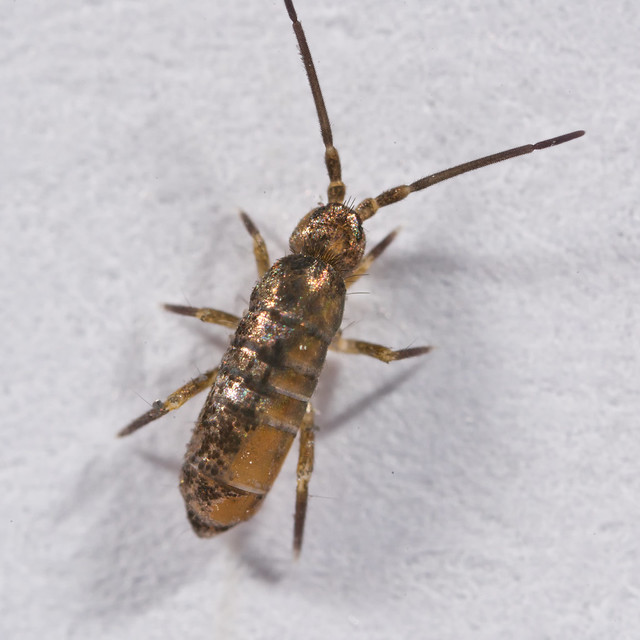
The predominant species in the leaf litter was Tomocerus minor. Orchesella cincta was by far the most dominant arboreal species with a few Entomobrya intermedia present, but we also turned up a single Isotomurus unifasciatus:
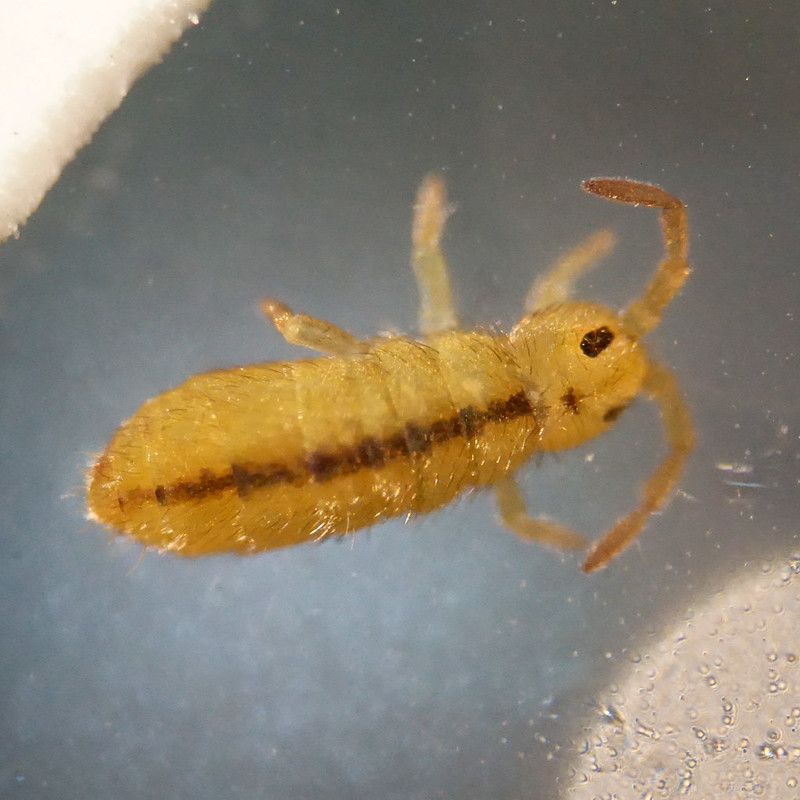
Isotomurus unifasciatus

The distinction between Isotomurus palustris and I. unifasciatus is that unifasciatus has a continuous dark line down its midline but is otherwise uniformly pale, while palustris has a slightly discontinuous dorsal line and mottled patterning on the sides of its abdomen.

Nothing terribly exciting, but given that no-one has ever recorded any springtails at all from this nature reserve, it's a start.

Saturday, 24 March 2018

Identification Guide to the Tomoceridae

Springtails in the family Tomoceridae are some of the most frequently encountered species in the UK for two reasons - they are very common and they are large. For this reason, although better identification keys are available, I think it's worthwhile publishing this simple version - hope it helps. If you don't understand all the technical terms (e.g. dens, furcula) and need help I suggest searching Google for images.

To begin at the beginning.

1. Orders: Springtails can be divided into three groups:
  • Globular springtails - rounded body shape
  • Poduromorpha - equal sized body segments
  • Entomobrymorpha - unequal sized body segments

2. Segmentation: The family Tomoceridae are part of the Entomobrymorpha. In the Tomoceridae, the third abdominal segment (abd3) is the longest, whereas in the Entomobryidae abd4 is longest. This characteristic is the first thing to look for and identifies a member of this family.

3. Antennae: All the Tomoceridae have relatively long antennae, but these are fragile and frequently break off so caution is needed unless all 4 antennal segments are present. In the Tomoceridae the third antennal segment (ant3) is longer than the others.

4. Antenna shape: All the species listed here were formerly in the genus Tomocerus but have now been split into two genera based on the shape of the antennae. If ant and ant4 taper towards the tip, go to 5. If the antennal segments do not taper significantly (nearly cylindrical), go to 6.

5. Genus Pogonognathellus:
In this genus, ant3 and ant4 taper towards the tip; ant3 is scaled, c.f. Tomocerus. The four anterior ocelli are in a diamond configuration. Pogonognathellus species have a pair of leaf-shaped scales at the base of the inside of the dens (c.f. Tomocerus). 

Pogonognathellus longicornis - very common, widespread. The antennae are longer than the body (including the head). This species frequently curls ant3 and ant4 into a tight spiral:
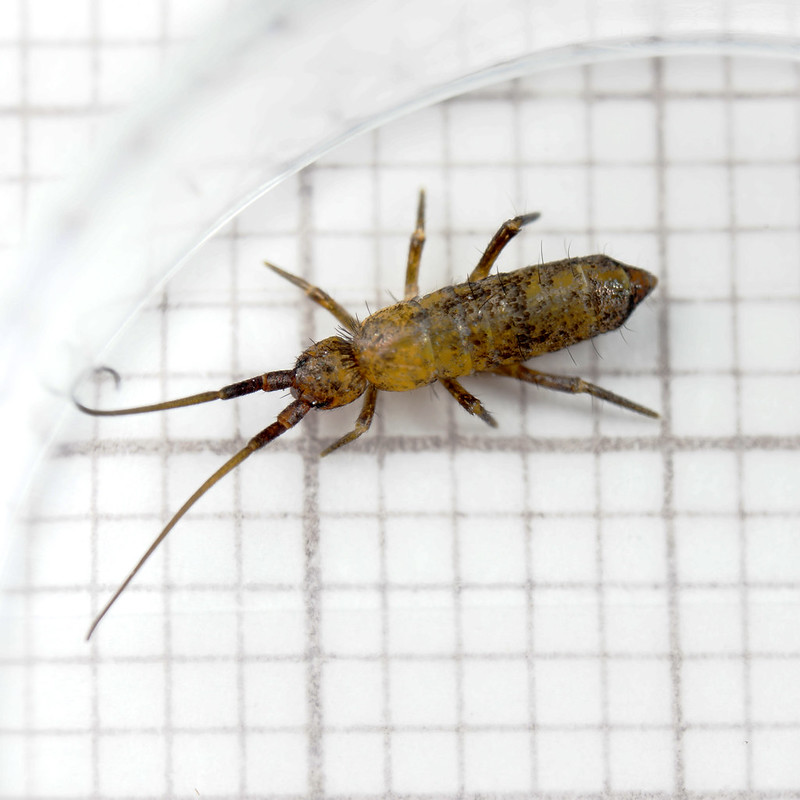
Pogonognathellus longicornis

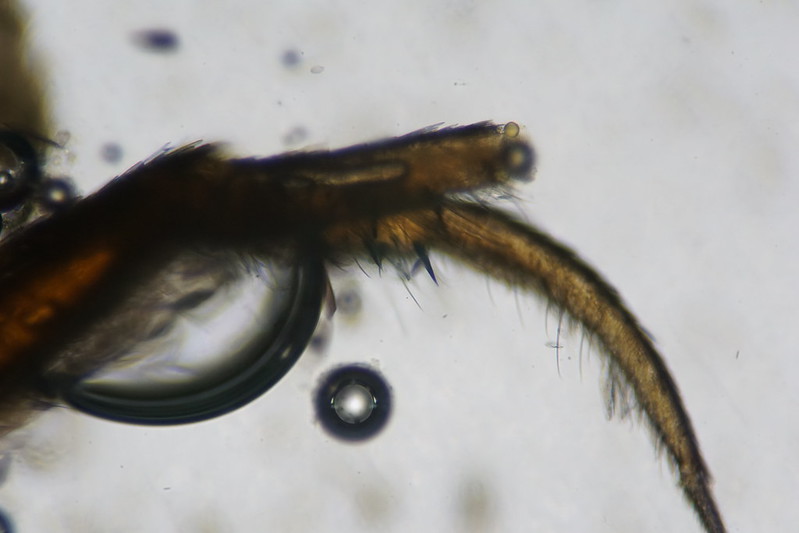
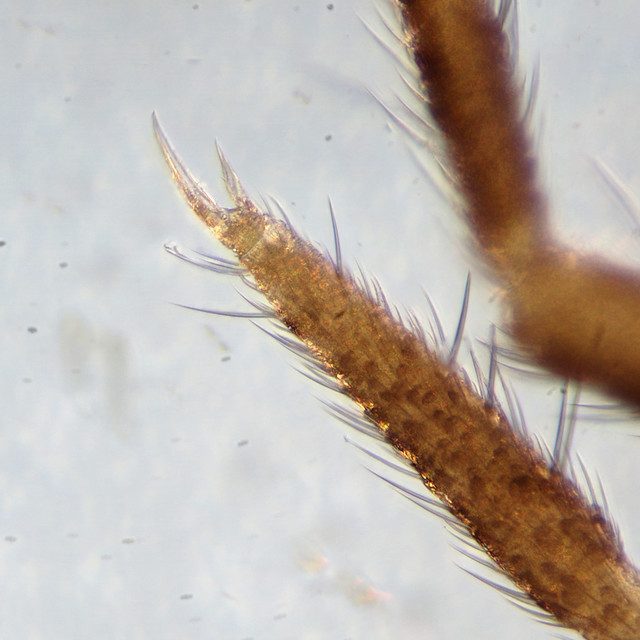
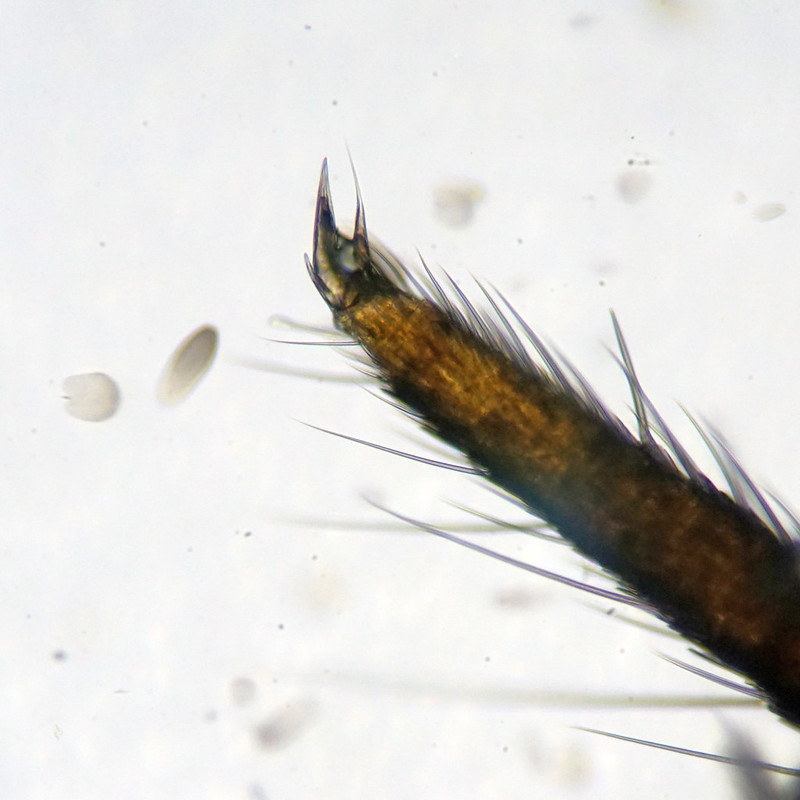
In addition, the empodium is about 1.2 times as long as the claw due a thin filament on its tip (c.f. P. flavescens (rare) - no filament on any empodium):
Pogonognathellus longicornis - Empodium

Pogonognathellus flavescens - scarce, a more upland species.
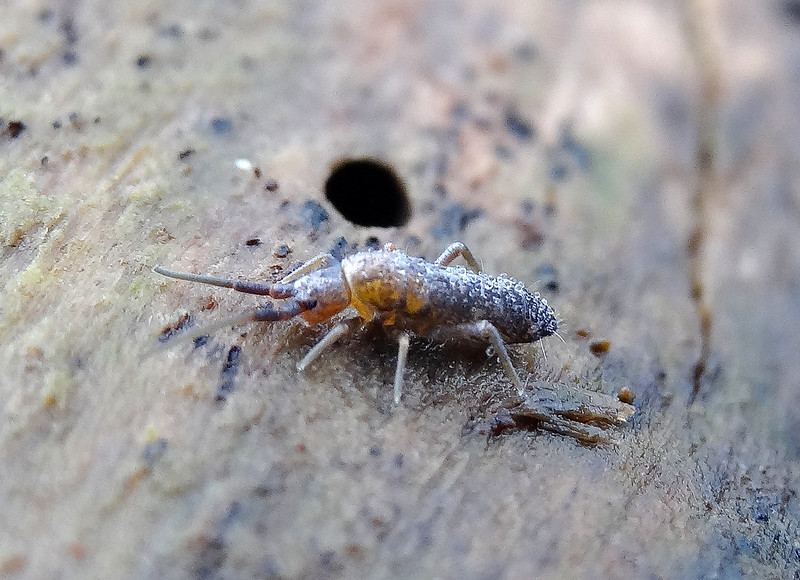
The antennae taper but the intact antennae are shorter than the body (including the head):
Pogonognathellus flavescens

Note that in spite of the name, yellow colouration is not characteristic for this species - see below. If in doubt (e.g. if the antennae are broken, check the empodium (see above) which is shorter than the claw.


6. Genus Tomocerus:
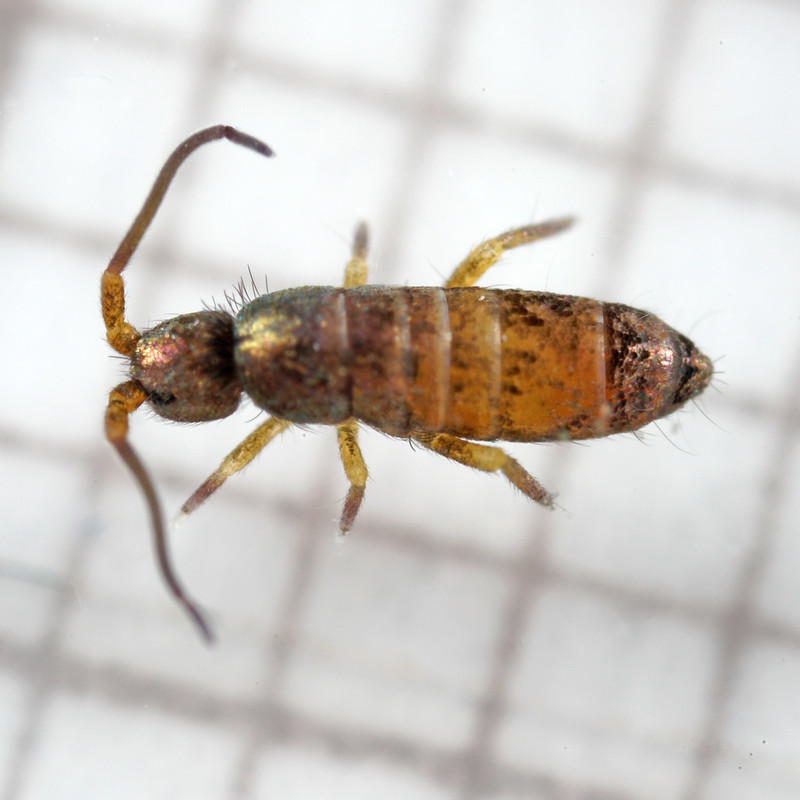
In this genus the antennal segments do not taper significantly (nearly cylindrical). The four anterior ocelli are in a square configuration. Ant3 is not scaled and cannot curl (ant4 can be curled slightly).

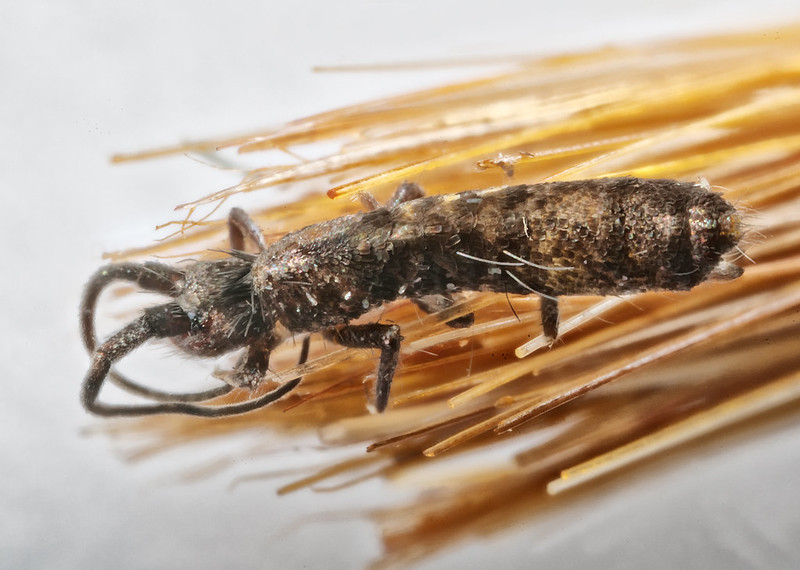
Tomocerus minor - very common, widespread:
Tomocerus minor

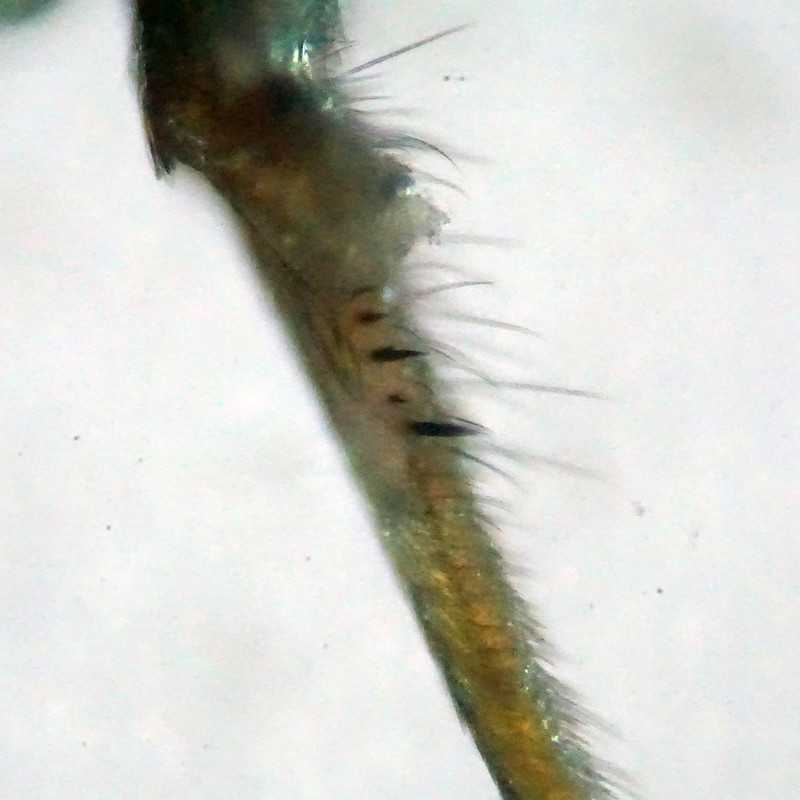
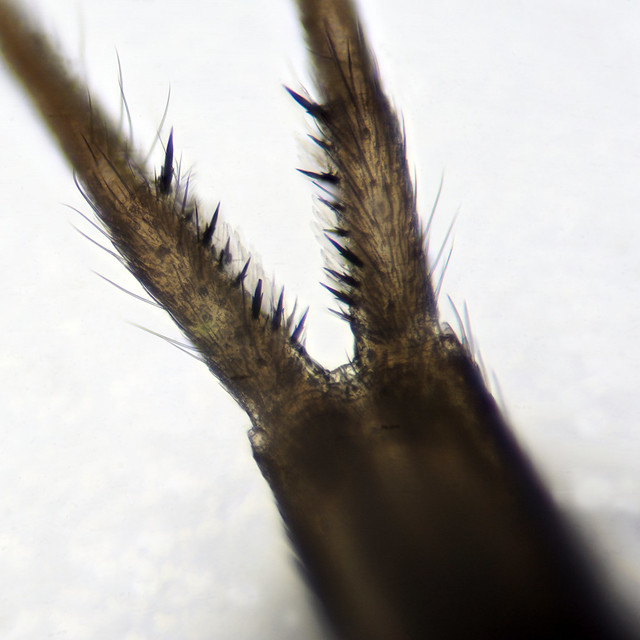
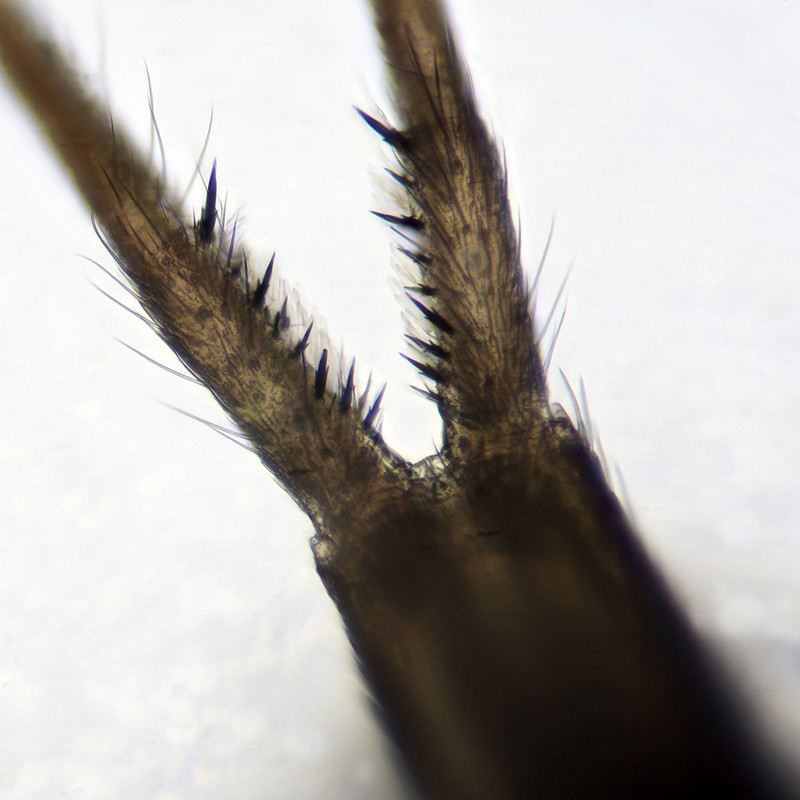
Separation this species from T. vulgaris requires examination of the spines on the dens (part of the furcula). In T. minor these are tridentate (three teeth):
Tomocerus minor - Dens


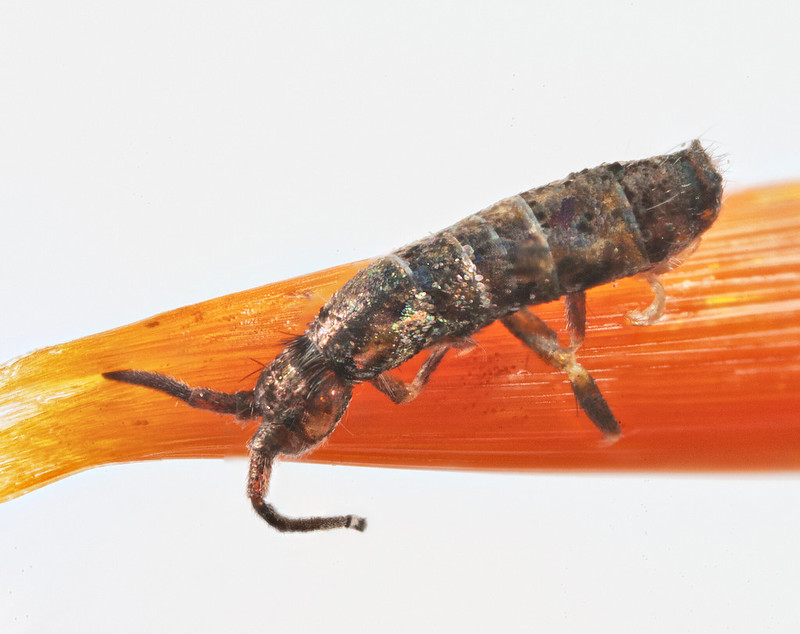
Tomocerus vulgaris - common, widespread. Characterised by transverse iridescent bands of scales in natural light (may not be visible with flash):

Tomocerus vulgaris

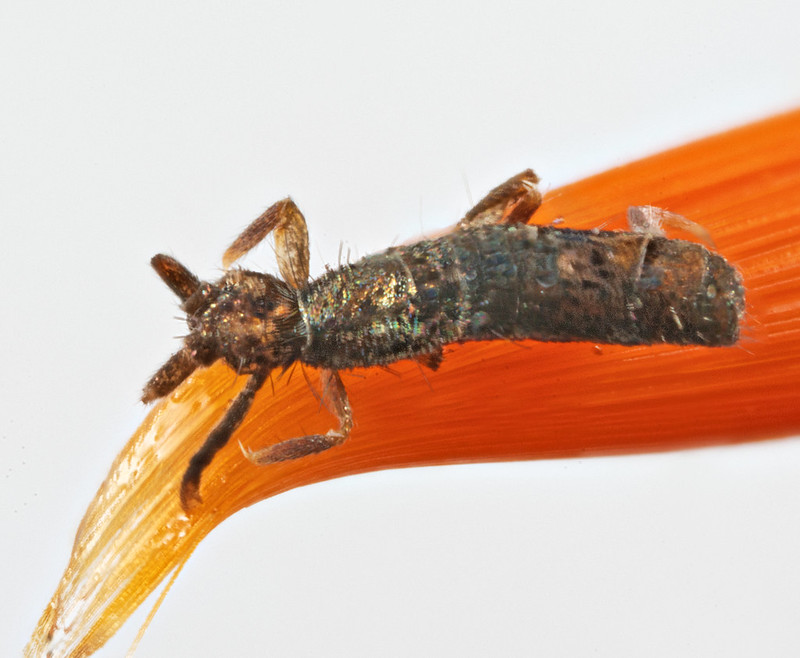
However the scales are easily lost - see below. Partially descaled T. vulgaris:
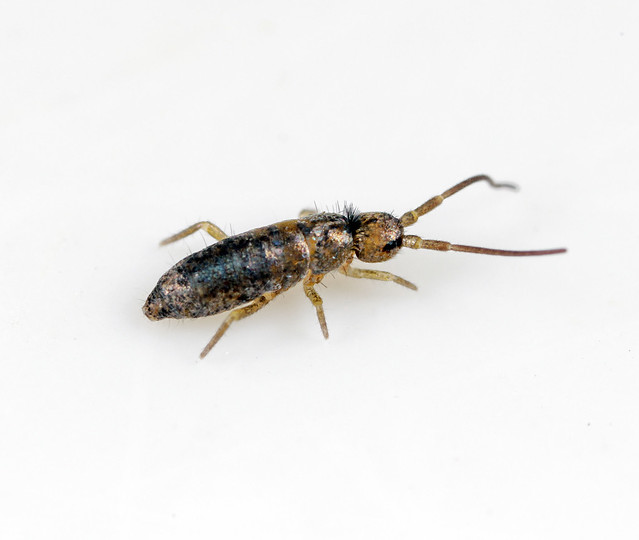
Tomocerus vulgaris

Tomocerus minor/vulgaris can only be accurately confirmed by the the presence of simple (rather than three-pointed) spines on the dens (part of the furcula). In T. vulgaris these are simple (no teeth on the spines, c.f. T. minor above):

Tomocerus vulgaris dens


There is one further UK species in this family, Tomocerus minutus, but this is extremely rare and has only been reported from mountain tops in Scotland and Wales. No specimens of this species exist, so it cannot be confirmed and should be ignored (unless you're on a mountain top and find a Tomocerus which does not look like any of the above). Unlike other Tomocerus and Pogonognathellus species which have have several teeth (up to ~9) on the mucro, T. minutus only has 1-2 teeth on the mucro.


The problem with scales
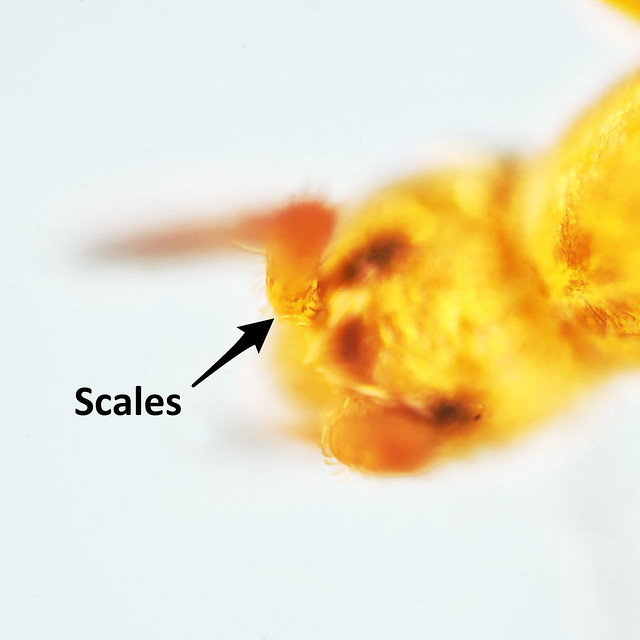
All the Tomoceridae are covered with dark and/or iridescent scales. At least, they start out with scales, but these are easily lost, revealing a golden body colour underneath. Scales and scale patterns are thus not a reliable identification characteristic in this group (and I should know, it's fooled me more than once!
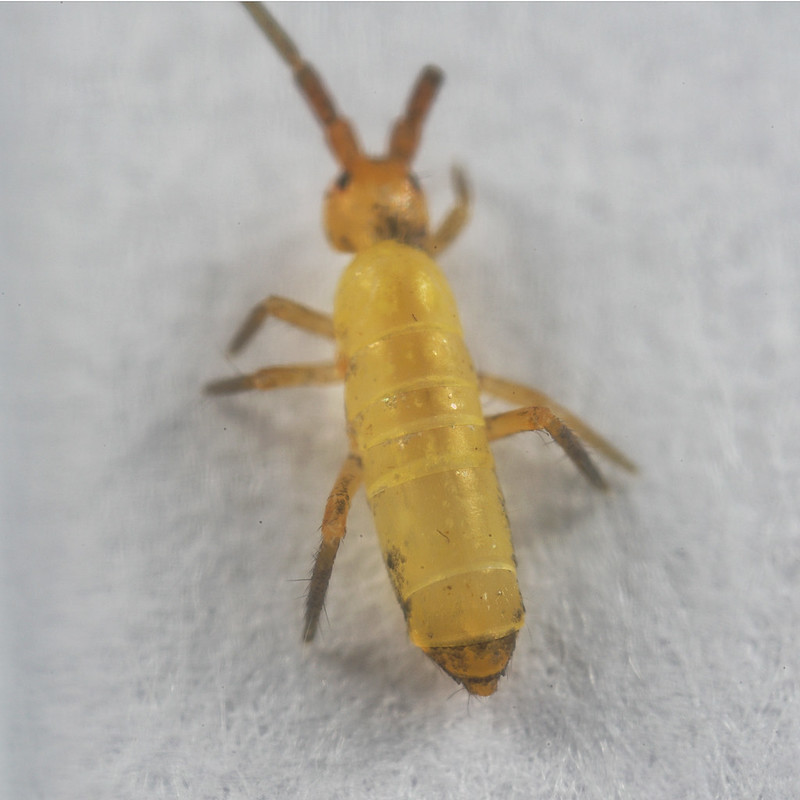
Pogonognathellus longicornis


Other Identification Guides: https://collembolla.blogspot.co.uk/p/identification-guides.html
Thursday, 22 March 2018

These Three Are Not The Same

A local recorder asked if I would confirm the I.D. of some springtails they had collected in Leicestershire so they could be recorded. Although they were dead (and a bit desiccated) when I received them, they turned out to be three different species.


The first (and largest) was fairly obviously Pogonognathellus longicornis:
Pogonognathellus longicornis

However, as the antennae were broken, I confirmed this by looking at the structure of the foot. In P. longicornis, the empodium is about 1.2 times as long as the claw due a thin filament on its tip (P. flavescens has no filament on any empodium):
Pogonognathellus longicornis - Empodium


The medium-sized specimen had some transverse banding on each segment and I thought it could be Tomocerus vulgaris:
Tomocerus vulgaris

To confirm this, I checked the structure of the spines on the dens of the furcula. Although this isn't the best picture, the spines were simple (not tridentate as in T. minor) so this is indeed T. vulgaris:
Tomocerus vulgaris - Dens


I guessed that the smallest specimen was probably Tomocerus minor:
Tomocerus minor

Indeed, it had tridentate spines on the dens of the furcula, confirming the I.D.:
Tomocerus minor - dens


Three very common species, but now formally recorded in an area of Leicestershire where no-one has ever recorded any springtails before! They're out there!

Saturday, 3 March 2018

Antennae - why do they break?

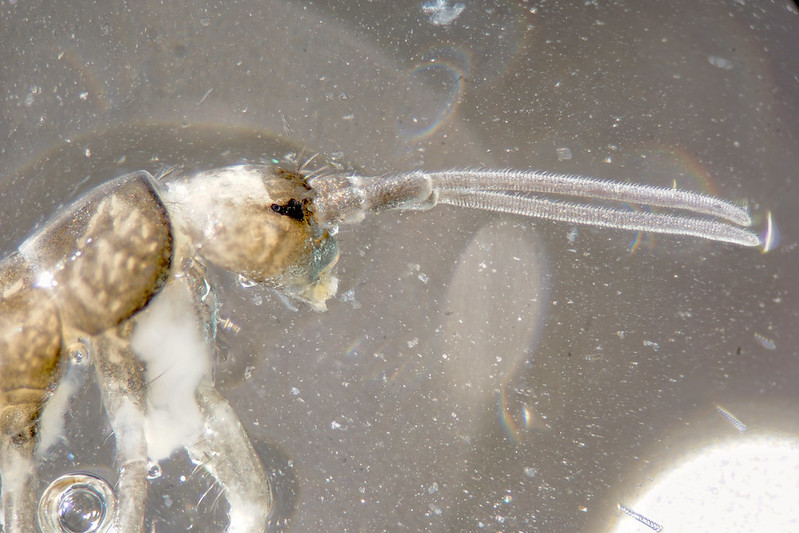
One of the characteristics of Tomocerus is that the third antennal segment (Ant3) is elongated. Ant1 & 2 have scales, Ant3 & 4 are not scaled and have an annular structure:

Tomocerus minor

I've been examining a lot of Tomocerus specimens recently - as this is such a common genus, it's hard not to. One of the frustrations is that the antennae of preserved Tomocerus are almost invariably damaged. I was wondering why this was, and the thought led me down a rabbit hole of zoological research...

Hexapods possess one of two types of antennae, segmented or annulated (Imms, A.D. (1939) Memoirs: on the antennal musculature in insects and other arthropods. Journal of Cell Science, 2(322), 273-320). Springtails typically have segmented antennae while higher hexapods such as insects have annulated antennae. For both types, the first two antennal segments contain both extrinsic muscles (anchored outside the antenna) and intrinsic muscles, contained completely within the antenna.

However, there is variation within the Collembolla, and in families such as the Sminthuridae, and the genera Tomocerus and Orchesella, the terminal one or two segments have an annular structure which is devoid of muscles, and thus fragile and prone to breakage. Did this evolve to frustrate people who study springtails? Presumably not! But why would a springtail need such a hybrid antennal structure? Springtails are on the diet of many predators and a significant proportion of unsuccessful attacks by the predator Notiophilus biguttatus (Carabidae) on Orchesella cincta results in damage to the antennae (Ernsting, G., & Fokkema, D.S. (1982. Antennal damage and regeneration in springtails (Collembola) in relation to predation. Netherlands Journal of zoology, 33(4), 476-484). Being able to sacrifice part of your antennae (and regenerate then in subsequent moults - antennal damage results in an increase in moulting frequency) is better than being eaten.

Johnson's organ, an acoustic sensory organ in the second antennal segment, is absent in springtails (Imms, A.D. (1940) On growth processes in the antennae of insects. Quart. J. Microsc. Soc, 81, 585-593), presumably meaning that while they may be able to detect vibrations, springtails are essentially deaf (Goepfert, M.C., & Hennig, R.M. (2016) Hearing in insects. Annual review of entomology, 61, 257-276). With springtails, it's all about the pheromones.

Thursday, 1 March 2018

Tomocerus minor

Tomocerus minor

Tomocerus minor is an extremely common and widespread species, up to ~4.5mm long. As will all all Tomocerus species, the body is heavily covered in dark scales, but these can be easily lost in preserved specimens, changing the appearance to a golden colour:

Tomocerus minor

In T. minor, the empodium of the foot is about two-thirds the length of the claw:

Tomocerus minor - Claw

The spines on the inner side of the dens are tridentate, a highly characteristic feature which makes it impossible to confuse with any other species:

Tomocerus minor - Dens

Males can be recognized by the presence of a genital plate with circumgenital setae, absent in females, as seen here.

Tuesday, 27 February 2018

The problem with scales

Scales are often used as an identification feature for springtails. The problem is, scales are easily lost. Take this specimen of Tomocerus minor:

Tomocerus minor

Tomocerus species are heavily scaled and this gives them their characteristic dark colour. But the scales are easily lost - the left side of the abdomen of this specimen shows the dark scales, but on the right side it looks like a golden coloured animal. Scales in specific locations are a diagnostic feature for many species, e.g. Lepidocyrtus lignorum has scales on the basal segments of the antennae:

Lepidocyrtus lignorum

I use a small paintbrush to manipulate springtails - I find the easiest way to pick them up is with a moist brush. This often dislodges scales, but using a pooter to move springtails is also quite rough. Scales are also commonly lost from specimens preserved in 70% isopropanol. So the answer to the missing scales problem is:

  • If scales are an important identification feature and you can see them, you're a winner.
  • But if you can't see any scales, it doesn't mean they weren't there originally - keep this in mind.