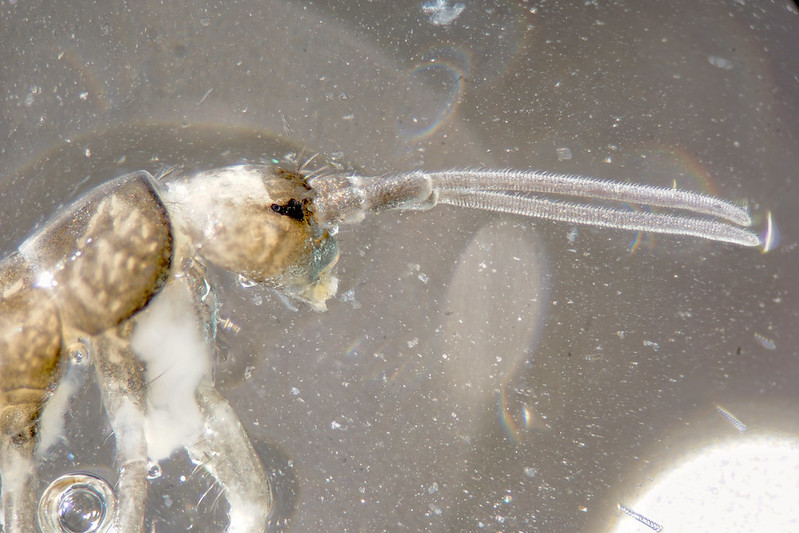
One of the characteristics of
Tomocerus is that the third antennal segment (Ant3) is elongated. Ant1 & 2 have scales, Ant3 & 4 are not scaled and have an annular structure:
I've been examining a lot of
Tomocerus specimens recently - as this is such a common genus, it's hard not to. One of the frustrations is that the antennae of preserved
Tomocerus are almost invariably damaged. I was wondering why this was, and the thought led me down a rabbit hole of zoological research...
Hexapods possess one of two types of antennae, segmented or annulated (Imms, A.D. (1939) Memoirs: on the antennal musculature in insects and other arthropods. Journal of Cell Science, 2(322), 273-320). Springtails typically have segmented antennae while higher hexapods such as insects have annulated antennae. For both types, the first two antennal segments contain both extrinsic muscles (anchored outside the antenna) and intrinsic muscles, contained completely within the antenna.
However, there is variation within the
Collembolla, and in families such as the
Sminthuridae, and the genera
Tomocerus and
Orchesella, the terminal one or two segments have an annular structure which is devoid of muscles, and thus fragile and prone to breakage. Did this evolve to frustrate people who study springtails? Presumably not! But why would a springtail need such a hybrid antennal structure? Springtails are on the diet of many predators and a significant proportion of unsuccessful attacks by the predator
Notiophilus biguttatus (
Carabidae) on
Orchesella cincta results in damage to the antennae (Ernsting, G., & Fokkema, D.S. (1982. Antennal damage and regeneration in springtails (Collembola) in relation to predation. Netherlands Journal of zoology, 33(4), 476-484). Being able to sacrifice part of your antennae (and regenerate then in subsequent moults - antennal damage results in an increase in moulting frequency) is better than being eaten.
Johnson's organ, an acoustic sensory organ in the second antennal segment, is absent in springtails (Imms, A.D. (1940) On growth processes in the antennae of insects. Quart. J. Microsc. Soc, 81, 585-593), presumably meaning that while they may be able to detect vibrations, springtails are essentially deaf (Goepfert, M.C., & Hennig, R.M. (2016) Hearing in insects. Annual review of entomology, 61, 257-276). With springtails, it's all about the pheromones.