Showing posts with label Orchesella. Show all posts

Tuesday, 4 June 2019

The tale of the wonky Orchesella cincta

The tale of the wonky Orchesella cincta


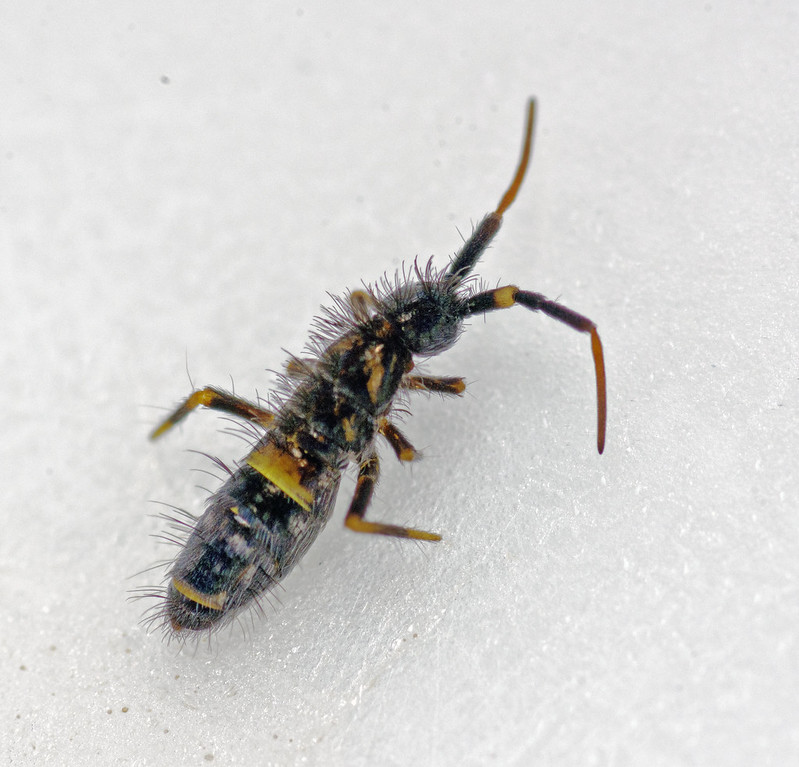
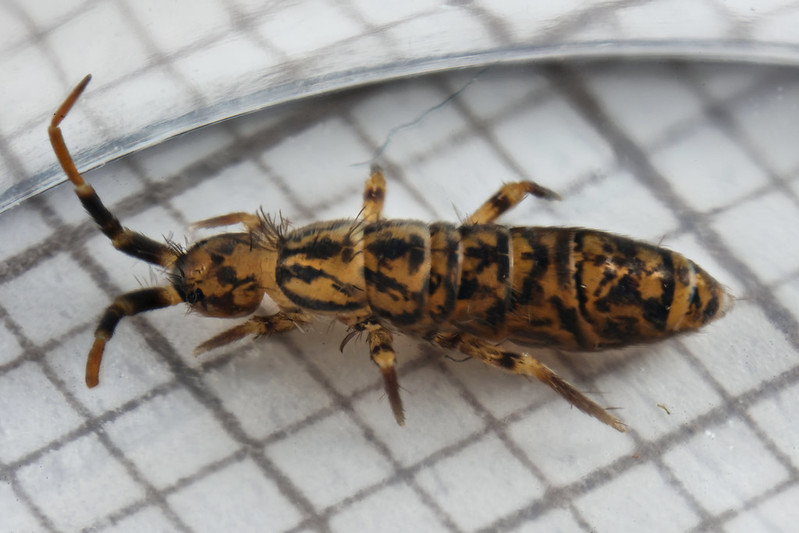
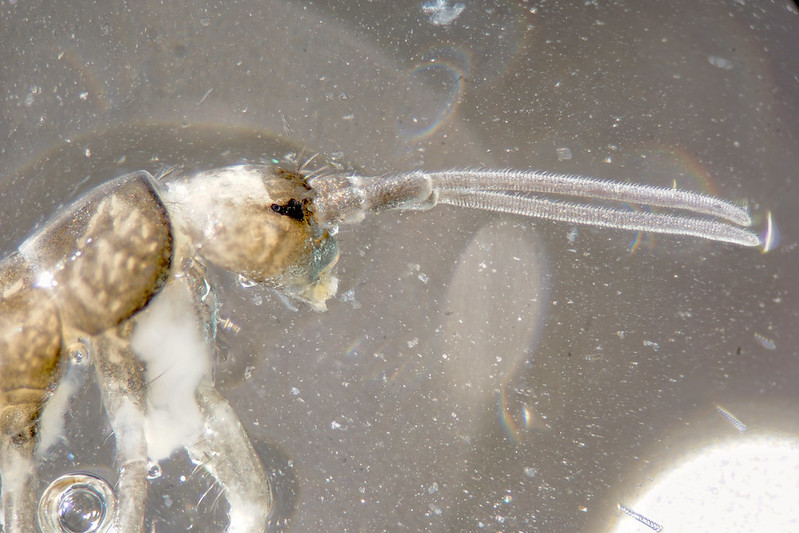
A single Orchesella cincta from the pitfall trap. The wonky antennae could be due to a number of reasons, but I'd bet my money on an encounter with a predator, during which many springtails are happy to regard antennae as "optional extras", useful though they are. Springtails are on the menu for pretty much every carnivorous or omnivorous species out there (although I haven't tried them myself yet - I bet they taste like chicken). Frustrating though this may be for springtails fans it's probably a good thing. Being knee deep in springtails would be a rather itchy experience. Those scales get everywhere.


Saturday, 2 March 2019

Competition time!

Competition time


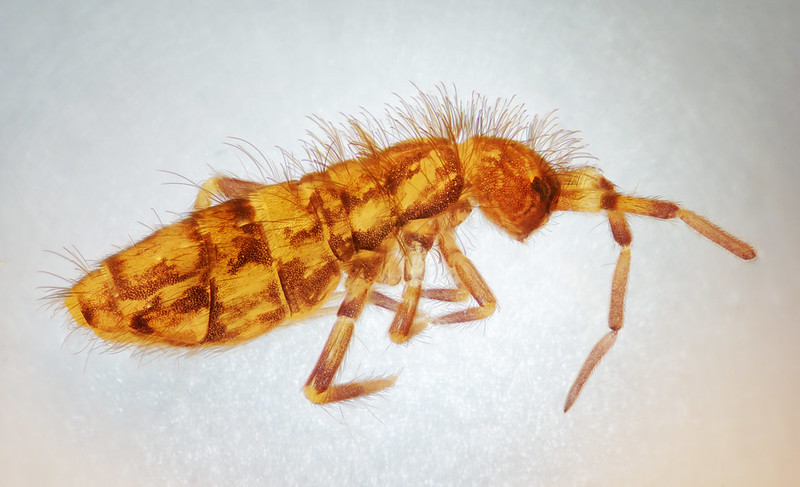
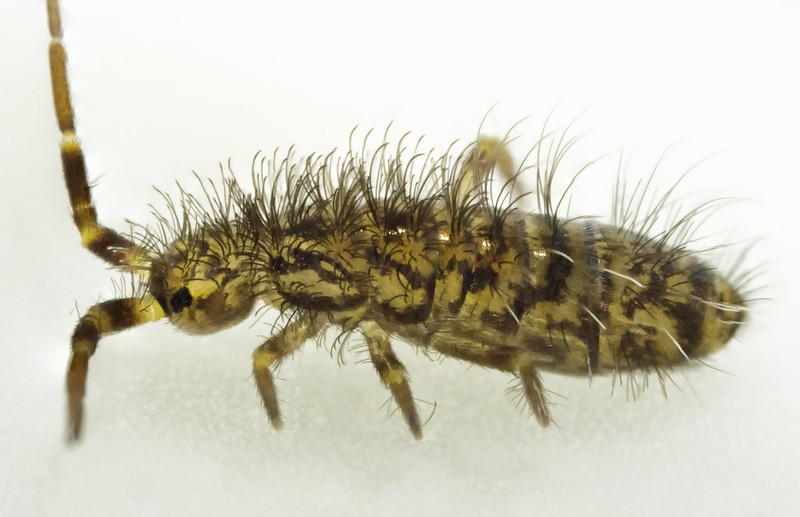
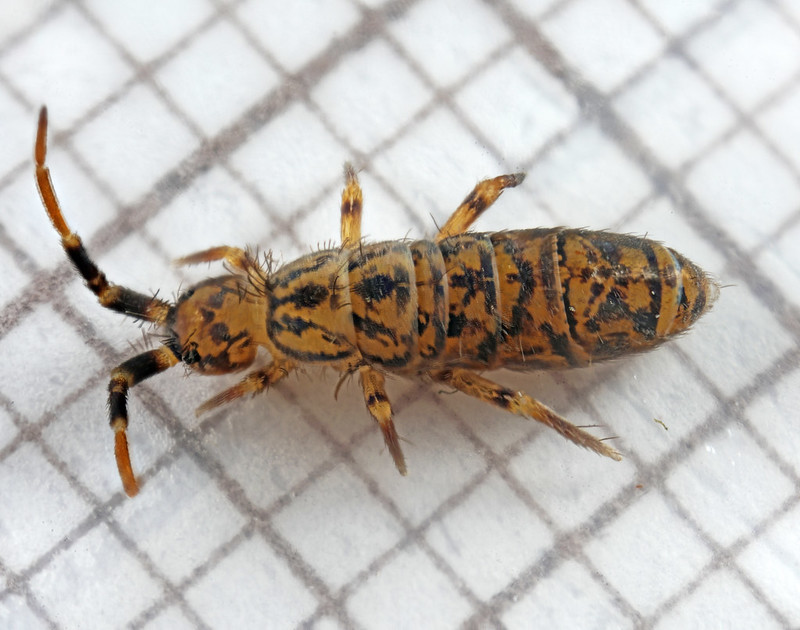
I find Orchesella can be quite difficult to identify in preserved specimens - much harder than live specimens. So two questions:

  1. Spot the odd one out!
  2. What features allow you to identify the two species in this picture?
 

Tuesday, 1 May 2018

Orchesella Identification Guide

The genus Orchesella is characterized by:
  • Body scales absent.
  • 6 antennal segments with ant1+2 both subdivided. However: one or both antennae may be reduced in length due to damage, and the first instars have only 4 antennal segments hence fail to key out.
  • Head with 7 + 7 or more eyes, postantennal organ absent.

There are five species on the UK checklist but only two are commonly encountered:

Orchesella cincta "Belted Springtail"
One of the commonest springtails in Britain, reaching ~4mm. Key feature: dorsal surface of abd3 fully pigmented (this can be important in preserved specimens).

Orchesella cincta

Juvenile (<6 antennal segments):
Orchesella cincta juvenile


Orchesella villosa "Shaggy Springtail"
Common and widespread, one of the largest springtails reaching ~5mm length. Pigmentation patterns on the body in patches and are variable but ant2-ant4 mostly dark(c.f. O. cincta). Long, backward curved macrosetae on abdomen (although these can be lost):
Orchesella villosa

Bald specimen:
Orchesella villosa

Orange/yellow "knees":
Orchesella villosa
 
 
Orchesella flavescens (rare) looks similar to O. cincta but the broad transverse bar is on abd3 rather than abd4 as in O. cincta. In addition, O. flavescens has two lateral longitudinal stripes (c.f. O. quinquefasciata - 5 longitudinal stripes). 


Saturday, 31 March 2018

25.03.18: Launde Park Wood

We had planned to visit a woodland site I've never been to before, but when we got close it was clear that it simply wasn't safe to proceed - far too wet. Although we had a little rain overnight I couldn't understand why the land was so wet - until several hours later when I figured out that the snow melt of the last month has saturated the ground in the east of the county and the steep clay slopes will take several months to dry out. So it was time for Plan B, which was a short diversion to a Launde Park Wood which has better access. We focussed on a steep east-facing slope covered in a mixture of Beech, Ash and Oak, sampling in the litter, under logs and brushing tree trunks.

The predominant species in the leaf litter was Tomocerus minor. Orchesella cincta was by far the most dominant arboreal species with a few Entomobrya intermedia present, but we also turned up a single Isotomurus unifasciatus:
Isotomurus unifasciatus

The distinction between Isotomurus palustris and I. unifasciatus is that unifasciatus has a continuous dark line down its midline but is otherwise uniformly pale, while palustris has a slightly discontinuous dorsal line and mottled patterning on the sides of its abdomen.

Nothing terribly exciting, but given that no-one has ever recorded any springtails at all from this nature reserve, it's a start.

Monday, 19 March 2018

Field Trip 17.03.18

The weather was so bad at the weekend that I didn't venture too far afield. By Saturday afternoon I had cabin fever and had to get out, so we walked over to the local churchyard to look for springtails. I'd had some quite good finds here in autumn looking under fallen leaves, such as Sminthurinus aureus:
Sminthurinus aureus


On Saturday things were much more hard going. For 20 minutes we couldn't find any springtails at all. I put this down to sub-zero temperatures and the very low humidity. Based on this, I decided that the best bet was to look for arboreal species which tend to be a bit more resistant to low humidity. This worked and we found some springtails by beating Ivy. There were lots of Orchesella cincta and quite a few Entomobrya. I was particularly interested in these as I am still looking for Entomobrya nivalis without success - even though it is regarded as "common" and has been recorded in the area.

Entomobrya species are identified by dorsal pigmentation patterns but by this point it was starting to snow again, so we beat a hasty retreat and took specimens home for identification (getting back just before a complete whiteout descended). Not surprisingly, most of the specimens were Entomobrya intermedia, but there was one juvenile I wasn't sure about as it was without the bottom of the "broken U" with the corners missing which signifies E. intermedia:

Entomobrya intermedia

However, this turns out to be merely a juvenile E. intermedia, so the quest for Entomobrya nivalis continues!

Saturday, 10 March 2018

The Brush Off

Brushes Some species of springtail can reliably be found in certain environments, e.g. Anurida maritima on the seashore, Entomobrya nivalis climbing up vegetation and grazing algae from tree trunks. Entomobrya nivalis is a bogey species for me. Although it is "very common", I've never found it! So I armed myself with my trusty paintbrush and a pot of invisible paint and went off to give the fruit trees in the garden a couple of coats of nothing but air. Getting into all the cracks and under bark flakes I could see the springtails raining down into the white plastic tub I was holding against the tree, and then, since it was flipping cold, I took them indoors to search for the elusive nivalis (more on paintbrushes here).


The first thing I found, fairly predictably, were lots of Entomobrya intermedia. Unlike E. nivalis, E. intermedia is truly common in these parts, but this was an encouraging start.
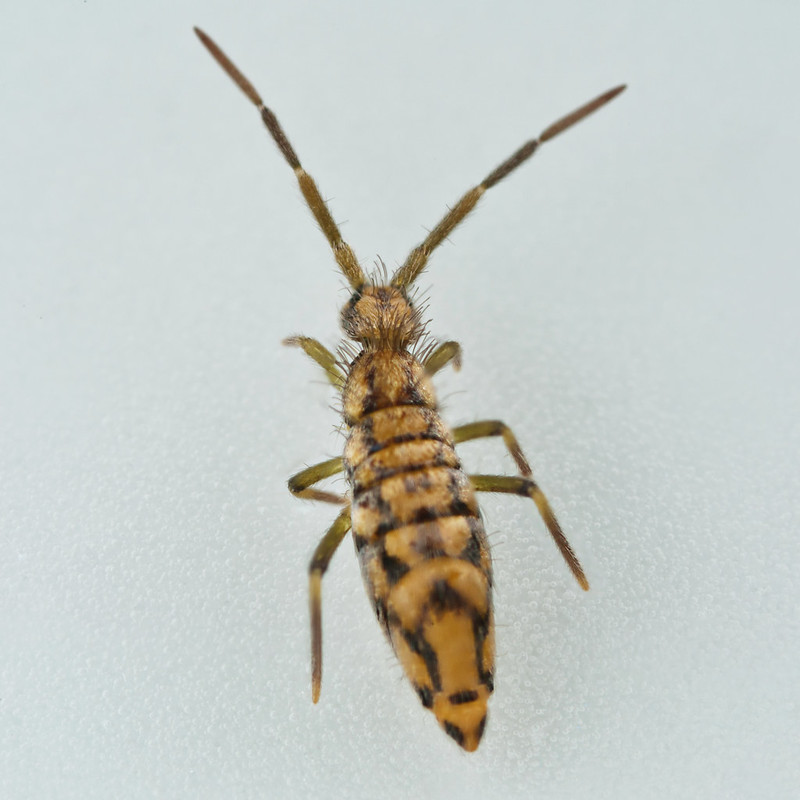
Entomobrya intermedia

One of the nice things about Entomobrya species is that they can fairly easily be identified from dorsal pigmentation patterns, and thus from photographs. E. intermedia has a characteristic broken “U” (the corners are missing) on abd.5/6 and a “W” across the top of abd.4. So far so good. After wading through all the intermedia, next up was a single specimen of Entomobrya multifasciata:

Entomobrya multifasciata

This species is characterised by the pair of triangular patches of pigment pointing forwards on the posterior margin of abd.4. Unfortunately it can be confused with female Entomobrya nigrocincta (a sexually dimorphic springtail), but I'm confident about this one and also very pleased as this is a new record for my garden. Sadly, at this point it all went a bit pear shaped. Sorting through the smaller specimens, I started to find a lot of these:
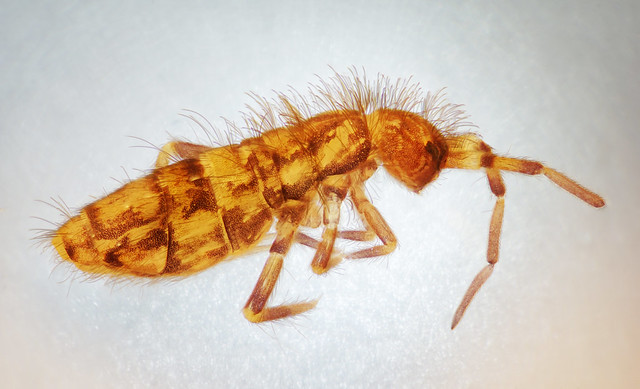
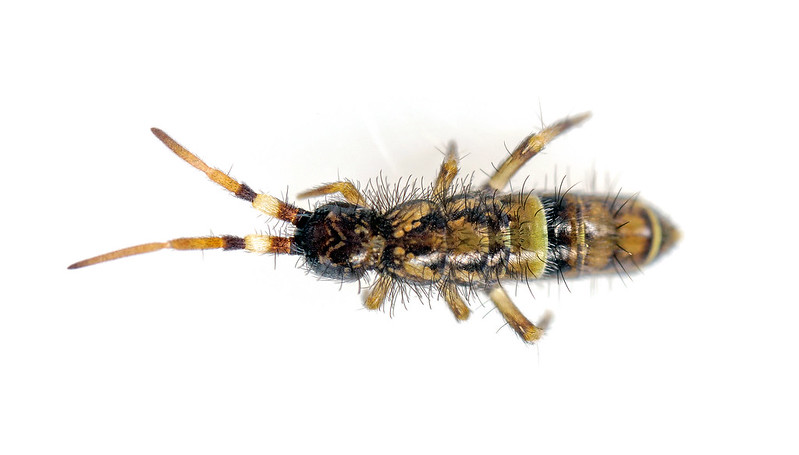
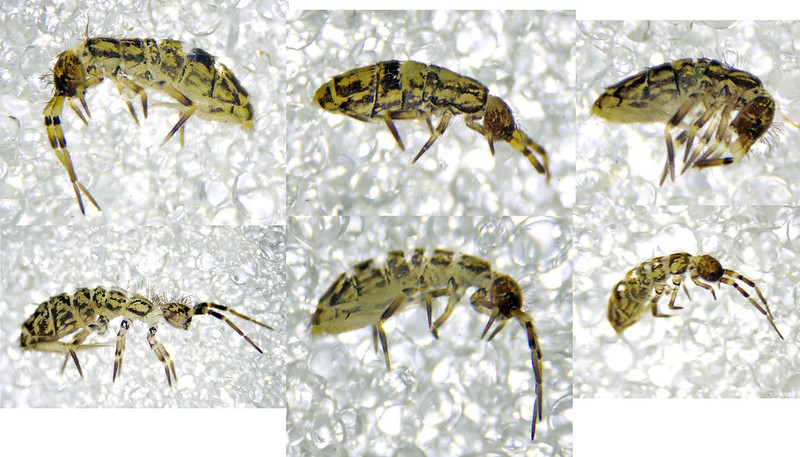
Orchesella cincta juvenile Orchesella cincta subadult

This tripped me up and caused a lot of head scratching trying to match up abdominal pigmentation patters with, well anything really. I'd become fixated on Entomobrya and failed to consider the other possibilities - rookie error. It wasn't until I found an adult and with assistance from Frans Janssens that the penny dropped:
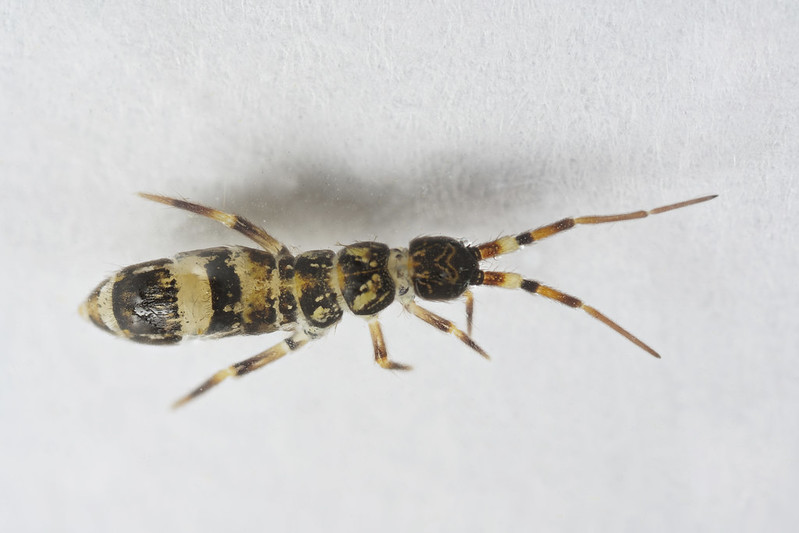
Orchesella cincta
Orchesella cincta

Unlike the juveniles I'd been finding, adult O. cincta are much darker - males are completely black (except for the white bands), females are less black and more spotted/patterned. This male is a bit battered and has lost quite a few scales and hairs so it's not a typical specimen but still quite recognisable. What I'd overlooked was that Entomobrya have 4 antennal segments, in Orchesella ant.1 and ant.2 appear to be divided so there appear to be 6 antennal segments (have another look at the juveniles above). The other problem is that all the instars of O. cincta appear different to each other - the first one above is a juvenile, the second one (with more dark pigment) is a subadult, but if you look at the antennae, you can see that they are not Entomobrya. Once again thanks to Frans Janssens for sorting me out.


Not a bad return on a pot of invisible paint! I may apply for Sky Arts Invisible Artist of the Year.

Saturday, 3 March 2018

Antennae - why do they break?

One of the characteristics of Tomocerus is that the third antennal segment (Ant3) is elongated. Ant1 & 2 have scales, Ant3 & 4 are not scaled and have an annular structure:

Tomocerus minor

I've been examining a lot of Tomocerus specimens recently - as this is such a common genus, it's hard not to. One of the frustrations is that the antennae of preserved Tomocerus are almost invariably damaged. I was wondering why this was, and the thought led me down a rabbit hole of zoological research...

Hexapods possess one of two types of antennae, segmented or annulated (Imms, A.D. (1939) Memoirs: on the antennal musculature in insects and other arthropods. Journal of Cell Science, 2(322), 273-320). Springtails typically have segmented antennae while higher hexapods such as insects have annulated antennae. For both types, the first two antennal segments contain both extrinsic muscles (anchored outside the antenna) and intrinsic muscles, contained completely within the antenna.

However, there is variation within the Collembolla, and in families such as the Sminthuridae, and the genera Tomocerus and Orchesella, the terminal one or two segments have an annular structure which is devoid of muscles, and thus fragile and prone to breakage. Did this evolve to frustrate people who study springtails? Presumably not! But why would a springtail need such a hybrid antennal structure? Springtails are on the diet of many predators and a significant proportion of unsuccessful attacks by the predator Notiophilus biguttatus (Carabidae) on Orchesella cincta results in damage to the antennae (Ernsting, G., & Fokkema, D.S. (1982. Antennal damage and regeneration in springtails (Collembola) in relation to predation. Netherlands Journal of zoology, 33(4), 476-484). Being able to sacrifice part of your antennae (and regenerate then in subsequent moults - antennal damage results in an increase in moulting frequency) is better than being eaten.

Johnson's organ, an acoustic sensory organ in the second antennal segment, is absent in springtails (Imms, A.D. (1940) On growth processes in the antennae of insects. Quart. J. Microsc. Soc, 81, 585-593), presumably meaning that while they may be able to detect vibrations, springtails are essentially deaf (Goepfert, M.C., & Hennig, R.M. (2016) Hearing in insects. Annual review of entomology, 61, 257-276). With springtails, it's all about the pheromones.