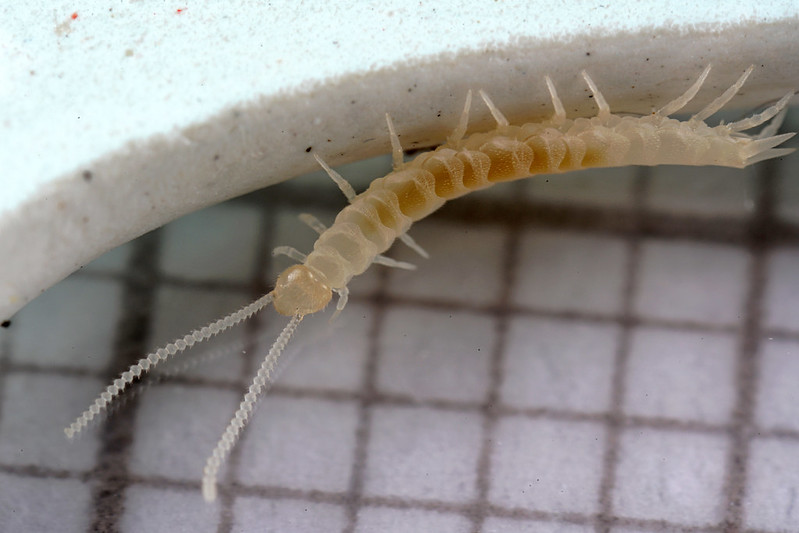
Scutigerella spp?
I was out in the woods recently looking for Diplurans (it's still a bit too early, not surprising considering we had snow on the ground a couple of weeks ago and have had some hard frosts). I found a lot of "minibeasts" - several under each log I looked under - and got excited, thinking I'd hit the Dipluran jackpot. Until I counted the legs. Hmm, given that Diplurans are hexapods ... 12 pairs of legs ... something not right here! I heard Alec Guinness in my ear "These are not the soil arthropods you're looking for". I took a few photos and moved on, assuming they were juvenile centipedes. Not expecting to be able to identify them to species level, I showed the photos to the wise men at the BMIG, who gently and kindly informed my these were Symphylans. What? You mean there's a whole Class of Myriapods that I've never heard of? Turns out there is:
Phylum: Arthropoda
Subphylum: Myriapoda
Class: Chilopoda - centipedes
Class: Diplopoda - millipedes
Class: Pauropoda - small millipede-like arthropods
Class: Symphyla - garden centipedes or pseudocentipedes
It also turns out (as I found out in the woods) that Symphylans are incredibly common - one of the most common animals in soil (Eisenbeis, G., & Wichard, W. (2012) Atlas on the biology of soil arthropods. Springer Science & Business Media). So why had I never heard of them? Because they've never been on a David Attenborough programme (Dear Sir Dave, don't you think it's a bit of an oversight that you've never talked about the commonest animals in Britain and probably the world? Yours, AJC). Steve Hopkin was doing a bit of work on this group before his untimely death (Hopkin, S.P. & Roberts, A.W. (1988) Symphyla – the least studied of the most interesting soil animals. Bulletin of the British Myriapod Group 5: 28-34). So I hit the literature and found out a bit more, including the features needed to identify them, but by then it was too late.
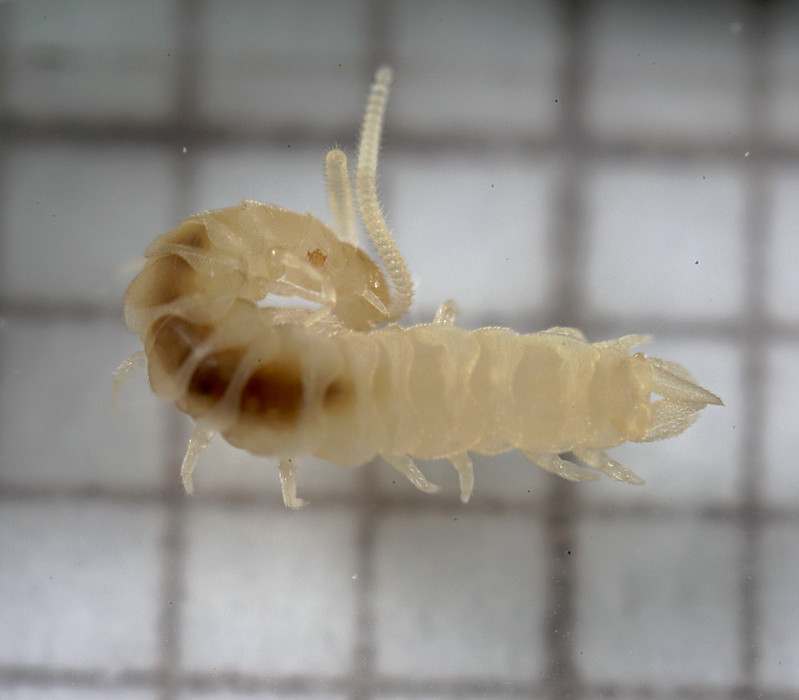
Scutigerella spp?
But I'll definitely be keeping an eye open for Symphylans in future. Identifying these beasties is a challenge - some features used by certain keys (number of legs and antennal segments) are variable - they start out with 6 legs and add a pair each time they moult, ending up with 10-12 pairs as adults (same thing with the number of antennal segments), but chaetotaxy and the features of the cerci are doable, so I'll be giving it a go. "Springtails of Leicestershire and Rutland" has a bit more of a ring to it than "Soil Arthropods of Leicestershire and Rutland", but if I manage to make any progress, expect to see more Symphylans popping up here.

