Showing posts with label Isotomurus. Show all posts

Sunday, 16 February 2025

Another instance of DNA not helping

Five years ago I had a crisis of confidence when Peter Shaw published his paper on DNA analysis of Lepidocyrtus - see: Big trouble in Lepidocyrtus. DNA analysis made identification of Lepidocyrtus much worse rather than helping!  While I was trying to find my way through the mess, Matthew Shepherd commented "many soil animals ... don't really fit into the concept of a species", but went on to say "we can still learn a lot from lumping these morpho-types together for recording purposes".  Frans Janssens commented "please continue to record ... based on morphology". Nevertheless I had lost a lot of confidence and so put Springtails on the back burner. 

Recently I worked up the courage to dip my toe in the DNA bathwater again. The Barcode of Life Data Systems (BOLD) project aims to derive taxonomic information from DNA barcodes: https://bench.boldsystems.org   From the BOLD website I obtained a useful result which supported the idea that some questionable Hemiptera morphotypes do indeed seem to be distinct species. Encouraged, I decided to go back to BOLD and try to figure out what I could derive for two of the most problematic Collembola groups. 

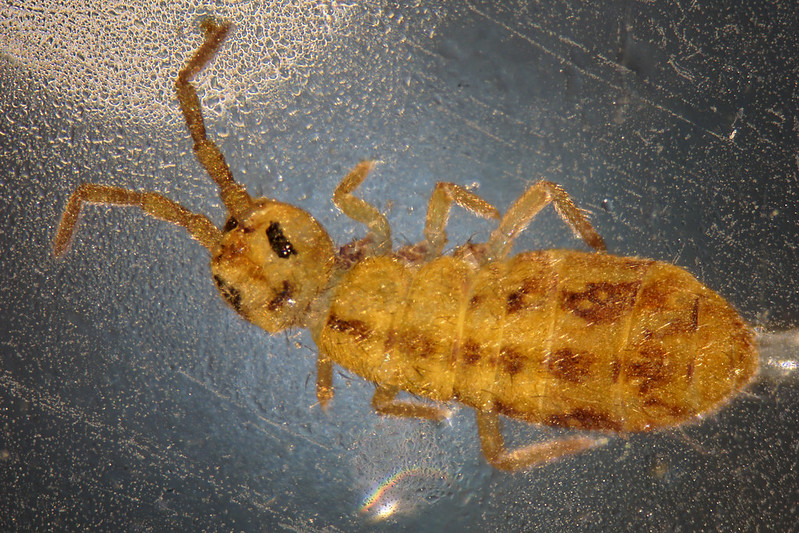
Species identification in Isotomurus is problematic because it relies on variable dorsal pigmentation patterns. In conversation Peter Shaw told me that he was planning DNA work on Isotomurus with an aim to review the genus, but sadly that didn't happen. Isotomurus records on BOLD currently consist of 727 records forming 43 BINs (clusters). (The Barcode Index Number System (BINs) clusters barcode sequences algorithmically. Since clusters show high concordance with species, this system can be used to verify species identifications as well as document diversity when taxonomic information is lacking.) A number of the Isotomurus BINs consist of single sequences representing unknown "species". BOLD lists 34 Isotomurus "species". DNA demarcation lines (BOLD BINs) and pigmentation patterns do not fully align. This doesn't really help me but at least it clarifies what the problem is - it's daft to identify morphospecies based on a single variable character such as pigmentation.

So far, so bad, but I also wanted to look at another problematic group, the Katiannidae (which includes Sminthurinus). Here BOLD has 5,250 records forming 294 BINs (clusters), with 51 "species" recognized by BOLD. It's widely acknowledged that the family Katiannidae is a mess and needs revision, but then I stumbled across a paper that I've been ignoring during my Collembola sabbatical: 
van Bezouw, R. F., McCulloch, J., Janssens, F., & Berg, M. P. (2022). An emended description of Sminthurinus lawrencei Gisin 1963, with notes on the identification of black Sminthurinus species. Soil Organisms, 94(3), 127-138. https://doi.org/10.25674/so94iss3id283

The great thing about this paper is that it uses a precise character (chaetotaxy - position and number of setae (hairs) on the dentes), rather than a variable one like pigmentation, to define morphospecies. While chaetotaxy is not a useful field characteristic, the paper also claims that macrophotography can be used to  separate the black Sminthurinus species. While I'm not ready to go back to Isotomurus, it might be time to pay Sminthurinus some attention again. 


Wednesday, 5 February 2020

Some like it wet


I recently bought myself a G-vac - for the uninitiated, a cordless garden leaf vacuum adapted for use as a bug vac - and I took it for its second outing this morning. How do you convert a leaf vacuum to a bug vac? Well essentially you tape a net bag over the mouth of the inlet tube. On a recommendation from a more experienced bug-vaccer I bought a nylon jam strainer bag to use for this (others use net curtain material). Now I will admit that the primary reason I bought the bug-vac was for spider work, and I wan't at all sure the jam strainer bag would retain insects as small as springtails, but on its first outing a couple of days ago I was delighted to find it worked with large spiders all the way down to springtails, including the little ones such as Lepidocyrtus.

A week or so ago, pre-vac, I had done some sampling in wet meadows beside the River Soar. At that time I'd spotted a patch of Juncus sitting in a damp hollow that looked interesting but I didn't have time to go there on my first visit. This morning I decided to go back and take a look, this time armed with the bug-vac. Bearing in mind this is a piece of electrical equipment, albeit double insulated to EU standards and designed to suck up wet leaves, I'm pretty cautious about mixing electricity and water because the 36V battery in the bug-vac could give out quite a jolt. I was therefore a bit alarmed that the bug-vac started spitting water out of the inlet when I stuck it in the Juncus, but the point of all this dicing with death is that the bug-vac turned up (alongside more run of the mill species) my first ever Isotomurus plumosus in VC55. I'm delighted but I won't be pushing my luck too far.


Saturday, 12 January 2019

Family Isotomidae

Isotomid characteristics:
  • unscaled
  • elongated body and body segments of approximately equal length (c.f. Entomobryidae, abd4 more than twice as long as abd3)
  • antennae with 4 segments of similar length
  • 8+8 ocelli
  • furca & PAO present
  • no anal spines
The presence and positioning of macrosetae (long hairs) and bothriotricha (mechanoreceptive hairs) are important in separating these genera. However, these are easily lost and may be missing. In this case you have to check whether or not empty sockets of macrosetae are present on the skin surface (difficult). Bothriotricha are often difficult to see even if present, but the pits in which they sit may be visible.

Ocelli:


Desoria - covered in short setae (hairs); ocelli B-D-E in straight line; mucro has four teeth but does not possess a lateral seta, apical tooth is large (c.f. Isotomurus); no teeth on manubrium (c.f. Isotoma); Hopkin key #224

Isotoma - long macrosetae on all body segments; ocelli C-D-E in straight line; mucro has three teeth; bothriotricha absent; Hopkin key #220

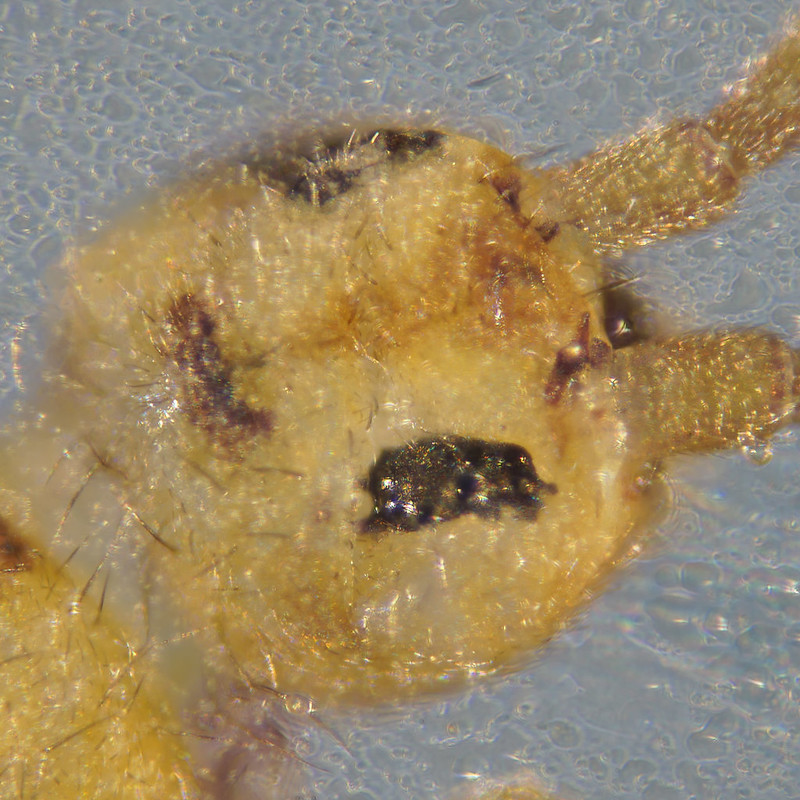
Isotomurus - long macrosetae on abd4-6 only; ocelli B-D-E in straight line; mucro has four teeth, apical tooth smaller than the others (c.f. Desoria); bothriotricha present; Hopkin key #209 (pigmentation patterns).

Vertagopus - no long macrosetae but a fuzzy cover of short setae; mucro has four teeth; tibiotarsi (adjacent to claws) have clavate tenant (knobbed) setae; only two British species; Hopkin key #215

Wednesday, 25 April 2018

Isotomurus Identification Guide

Isotomurus can be separated from Desoria and Istotoma by the configuration of the ocelli in the eyespot, but also by the distribution of long setae (macrosetae) on the body:
  • Istotoma: macrosetae on all body segments
  • Isotomurus: macrosetae on last few abdominal segments only
  • (Desoria: no macrosetae)

Many species in this genus were badly confused in the past and lumped together as "Isotomurus palustris". In recent years they have been separated into distinct species. Adult specimens have characteristic pigmentation patterns which makes identification easier than some other groups (juveniles are paler and often difficult to identify until they develop the characteristic patterns).

Mucro:
Desoria - mucro has four teeth but does not possess a lateral seta, apical tooth is large.
Isotoma - mucro has three teeth.
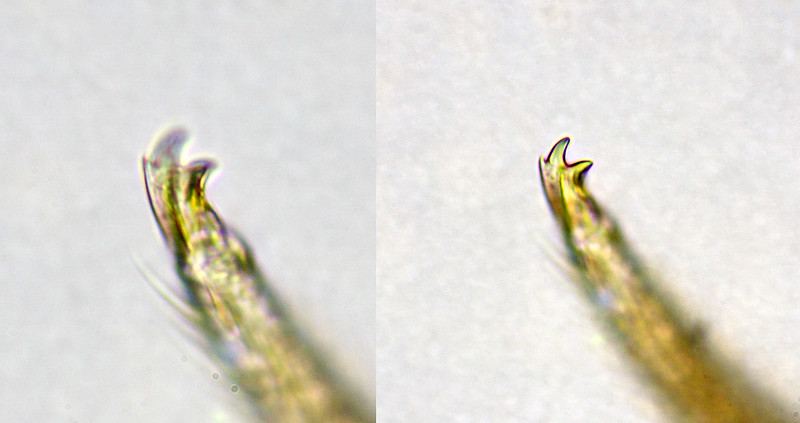
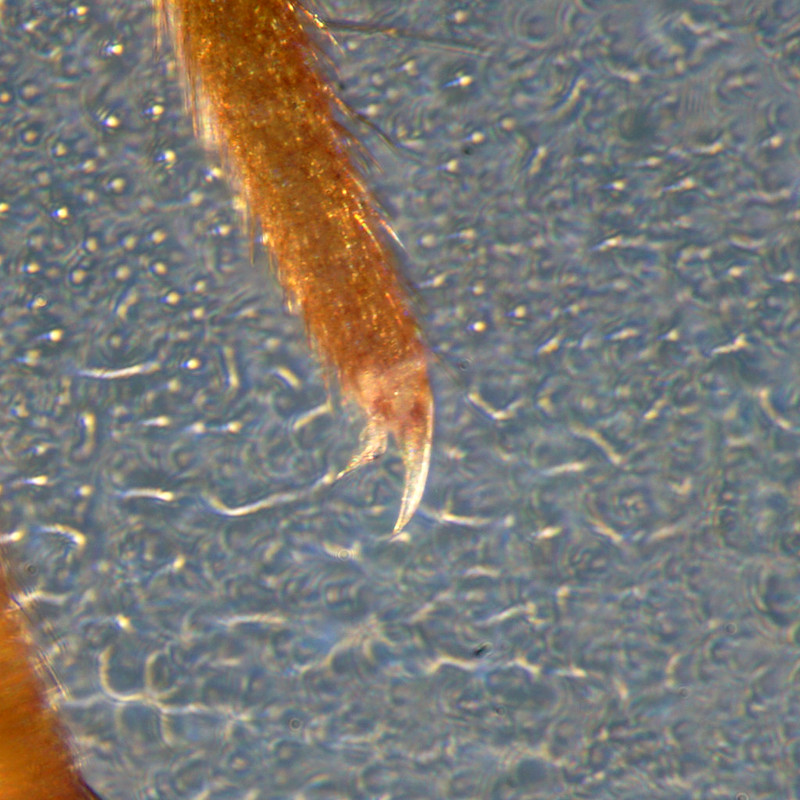
Isotomurus - mucro has four teeth, apical tooth smaller than the others:
Isotomurus Mucro


Isotomurus palustris has a near continuous dorsal line and fainter lines on the sides of its abdomen (juveniles are paler); mucro does not have a lateral seta. Species boundaries in Isotomurus are very difficult to determine and I. palustris is best recorded as I. palustris sensu lato unless there is very strong evidence to the contrary:

Isotomurus palustris sensu lato


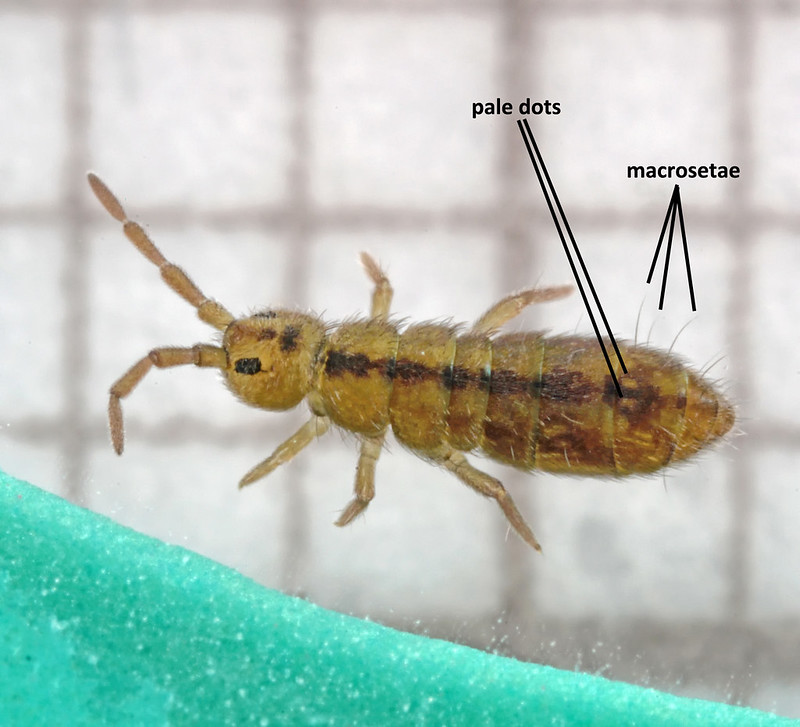
Isotomurus pseudopalustris has three macrosetae in triangular configuration on sides of abd4. Dark broken dorsal midline with two characteristic pale dots either side of midline on abd4. Adults have some pigmentation on sides of abdomen, juveniles are paler:
Isotomurus pseudopalustris


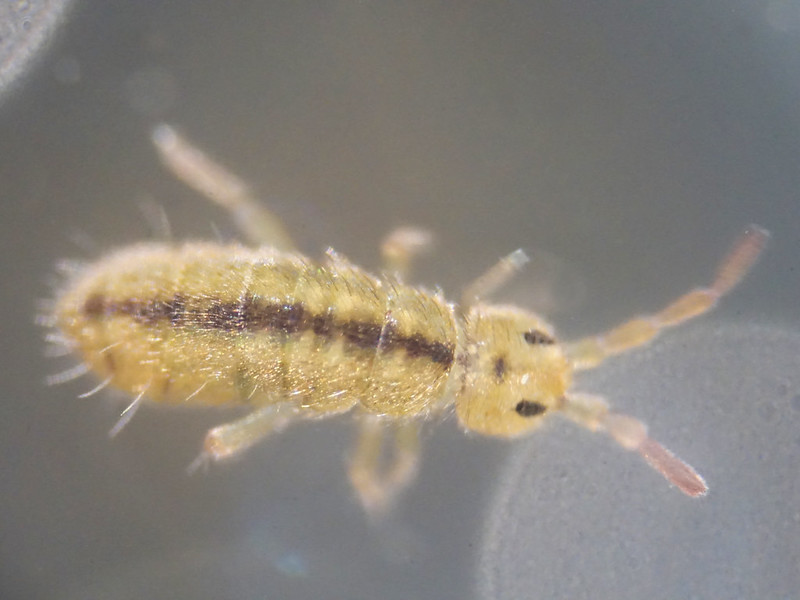
Isotomurus unifasciatus has a continuous dark line down its midline but is otherwise uniformly pale:
Isotomurus unifasciatus


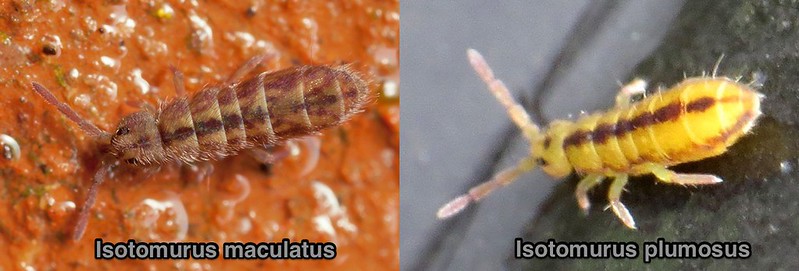
Isotomurus maculatus has a distinctive dorsal pattern resembling a backward facing crown;
Isotomurus plumosus has both an unbroken dark midline and lateral stripes:

Isotomurus


Other Identification Guides: https://collembolla.blogspot.co.uk/p/identification-guides.html

Saturday, 31 March 2018

25.03.18: Launde Park Wood

We had planned to visit a woodland site I've never been to before, but when we got close it was clear that it simply wasn't safe to proceed - far too wet. Although we had a little rain overnight I couldn't understand why the land was so wet - until several hours later when I figured out that the snow melt of the last month has saturated the ground in the east of the county and the steep clay slopes will take several months to dry out. So it was time for Plan B, which was a short diversion to a Launde Park Wood which has better access. We focussed on a steep east-facing slope covered in a mixture of Beech, Ash and Oak, sampling in the litter, under logs and brushing tree trunks.

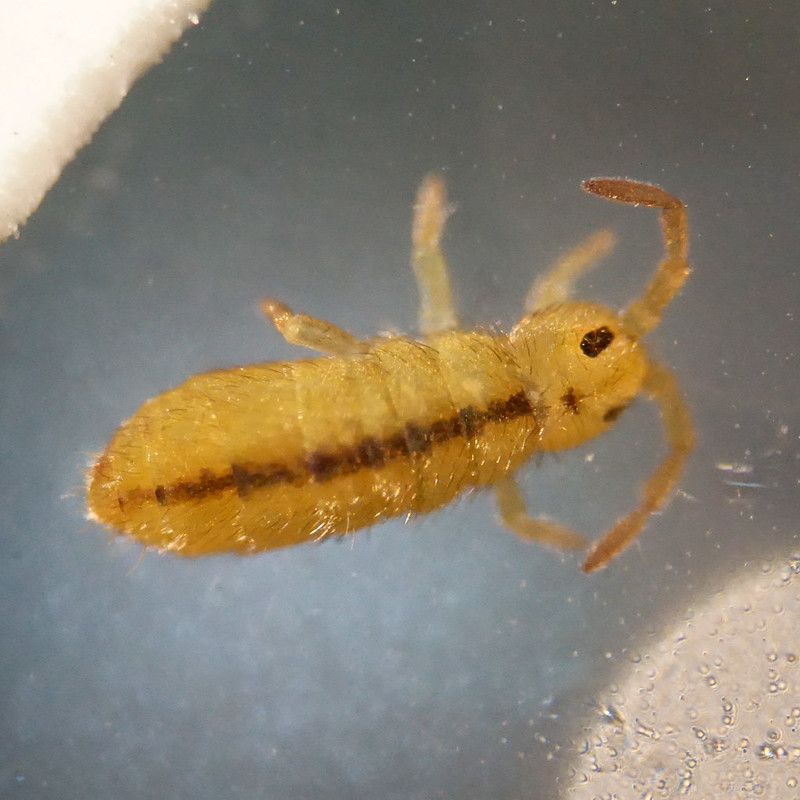
The predominant species in the leaf litter was Tomocerus minor. Orchesella cincta was by far the most dominant arboreal species with a few Entomobrya intermedia present, but we also turned up a single Isotomurus unifasciatus:
Isotomurus unifasciatus

The distinction between Isotomurus palustris and I. unifasciatus is that unifasciatus has a continuous dark line down its midline but is otherwise uniformly pale, while palustris has a slightly discontinuous dorsal line and mottled patterning on the sides of its abdomen.

Nothing terribly exciting, but given that no-one has ever recorded any springtails at all from this nature reserve, it's a start.

Tuesday, 13 March 2018

Isotomurus palustris

Desoria - covered in short setae (hairs)
Isotoma - long setae on all body segments
Isotomurus - long setae on abd5+6 only


The "Isotomurus palustris" group contain some of the commonest and most widespread springtails in the UK. In Isotomurus palustris sensu stricto, the central stripe is prominent and unbroken except at the dorsal margins of tergites, with a mottled pattern on the flanks.

Isotomurus palustris


Ocelli:
Isotomurus palustris - Ocelli


Claw:
Isotomurus palustris - Claw