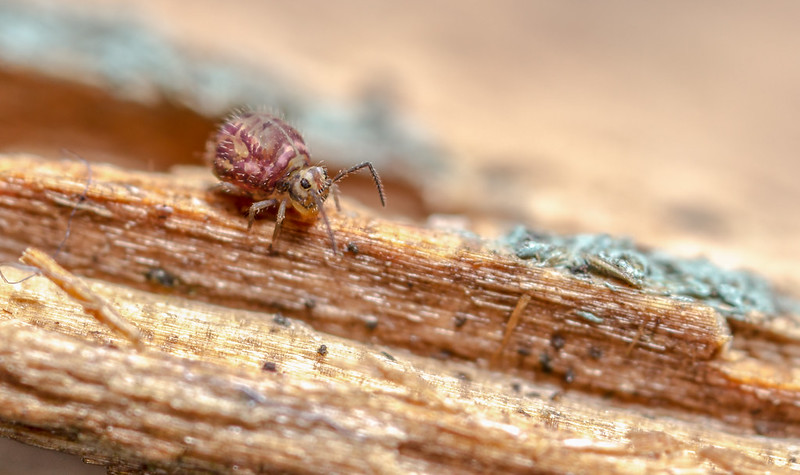
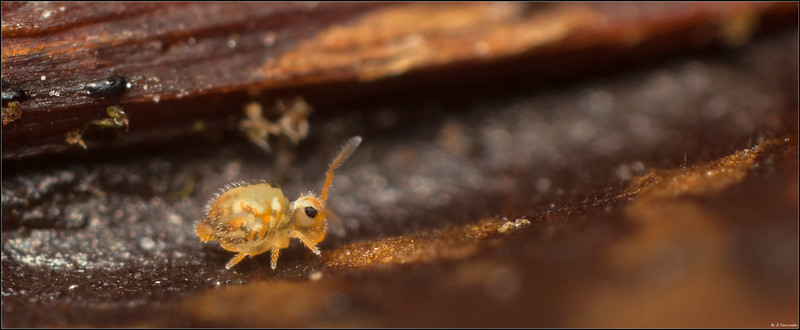
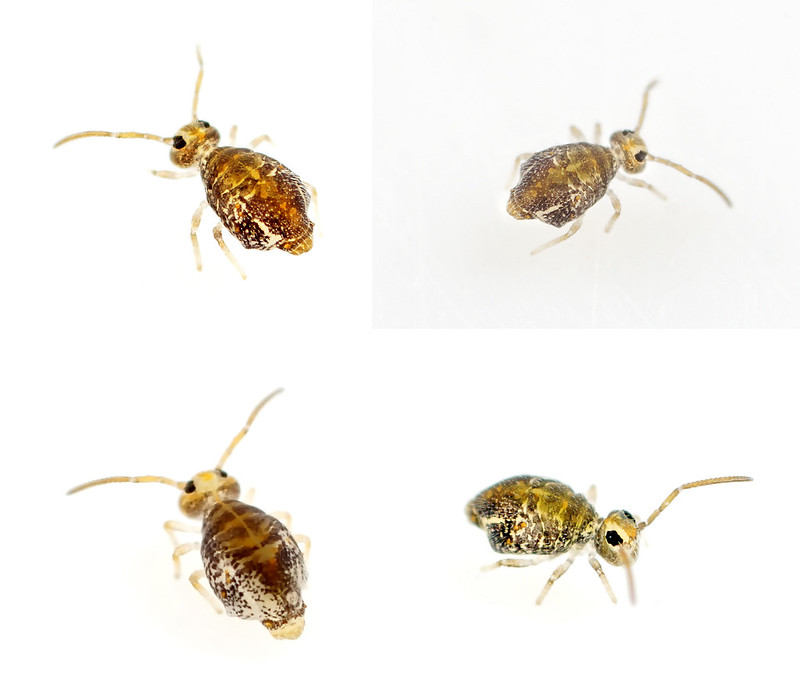
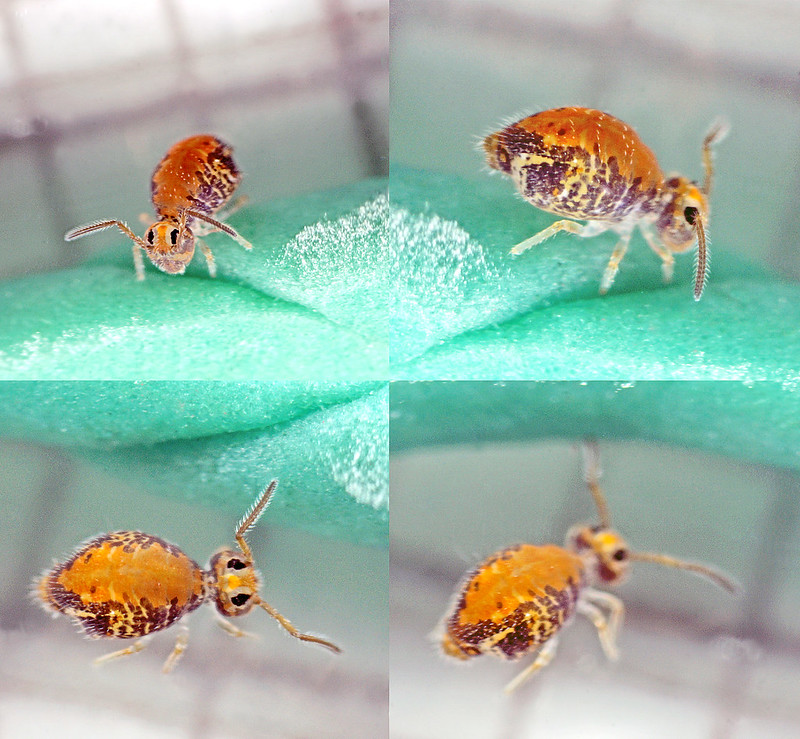
Showing posts with label Sminthurinus. Show all posts

Sunday, 16 February 2025

Another instance of DNA not helping

Five years ago I had a crisis of confidence when Peter Shaw published his paper on DNA analysis of Lepidocyrtus - see: Big trouble in Lepidocyrtus. DNA analysis made identification of Lepidocyrtus much worse rather than helping!  While I was trying to find my way through the mess, Matthew Shepherd commented "many soil animals ... don't really fit into the concept of a species", but went on to say "we can still learn a lot from lumping these morpho-types together for recording purposes".  Frans Janssens commented "please continue to record ... based on morphology". Nevertheless I had lost a lot of confidence and so put Springtails on the back burner. 

Recently I worked up the courage to dip my toe in the DNA bathwater again. The Barcode of Life Data Systems (BOLD) project aims to derive taxonomic information from DNA barcodes: https://bench.boldsystems.org   From the BOLD website I obtained a useful result which supported the idea that some questionable Hemiptera morphotypes do indeed seem to be distinct species. Encouraged, I decided to go back to BOLD and try to figure out what I could derive for two of the most problematic Collembola groups. 

Species identification in Isotomurus is problematic because it relies on variable dorsal pigmentation patterns. In conversation Peter Shaw told me that he was planning DNA work on Isotomurus with an aim to review the genus, but sadly that didn't happen. Isotomurus records on BOLD currently consist of 727 records forming 43 BINs (clusters). (The Barcode Index Number System (BINs) clusters barcode sequences algorithmically. Since clusters show high concordance with species, this system can be used to verify species identifications as well as document diversity when taxonomic information is lacking.) A number of the Isotomurus BINs consist of single sequences representing unknown "species". BOLD lists 34 Isotomurus "species". DNA demarcation lines (BOLD BINs) and pigmentation patterns do not fully align. This doesn't really help me but at least it clarifies what the problem is - it's daft to identify morphospecies based on a single variable character such as pigmentation.

So far, so bad, but I also wanted to look at another problematic group, the Katiannidae (which includes Sminthurinus). Here BOLD has 5,250 records forming 294 BINs (clusters), with 51 "species" recognized by BOLD. It's widely acknowledged that the family Katiannidae is a mess and needs revision, but then I stumbled across a paper that I've been ignoring during my Collembola sabbatical: 
van Bezouw, R. F., McCulloch, J., Janssens, F., & Berg, M. P. (2022). An emended description of Sminthurinus lawrencei Gisin 1963, with notes on the identification of black Sminthurinus species. Soil Organisms, 94(3), 127-138. https://doi.org/10.25674/so94iss3id283

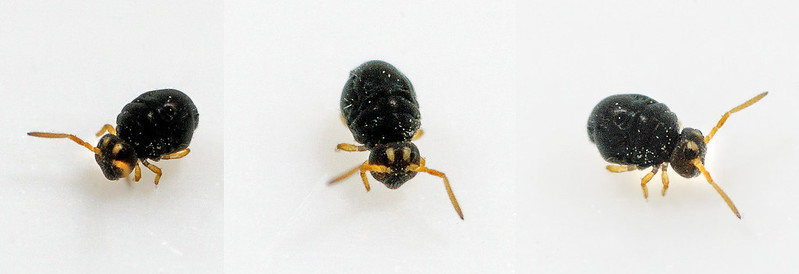
The great thing about this paper is that it uses a precise character (chaetotaxy - position and number of setae (hairs) on the dentes), rather than a variable one like pigmentation, to define morphospecies. While chaetotaxy is not a useful field characteristic, the paper also claims that macrophotography can be used to  separate the black Sminthurinus species. While I'm not ready to go back to Isotomurus, it might be time to pay Sminthurinus some attention again. 


Monday, 19 November 2018

Katiannidae

Family Katiannidae


Genus Katianna: www.collembola.org - Katianna

To the best of my knowledge there have been four "species" of Katiannidae recorded in the UK. All seem to be associated with the horticultural industry and to have been imported from Australasia:

Katianna (nr) australis (Photo: Mark Horton):

Katianna nr australis


Katianna (nr) schoetti (Photo: Edward Nurcombe):

Katianna nr schotti


Katiannidae genus nov.1 sp. nov. (with striped back):

Katiannidae genus nov.1 sp. nov.


Katiannidae genus nov.1 sp. nov.2 (with orange/red back):

Katiannidae genus nov.1 sp. nov.2


Genus Sminthurinus: www.collembola.org - Sminthurinus
This is a very difficult group with nearly 100 described "species". Badly needs a thorough taxonomic revision.

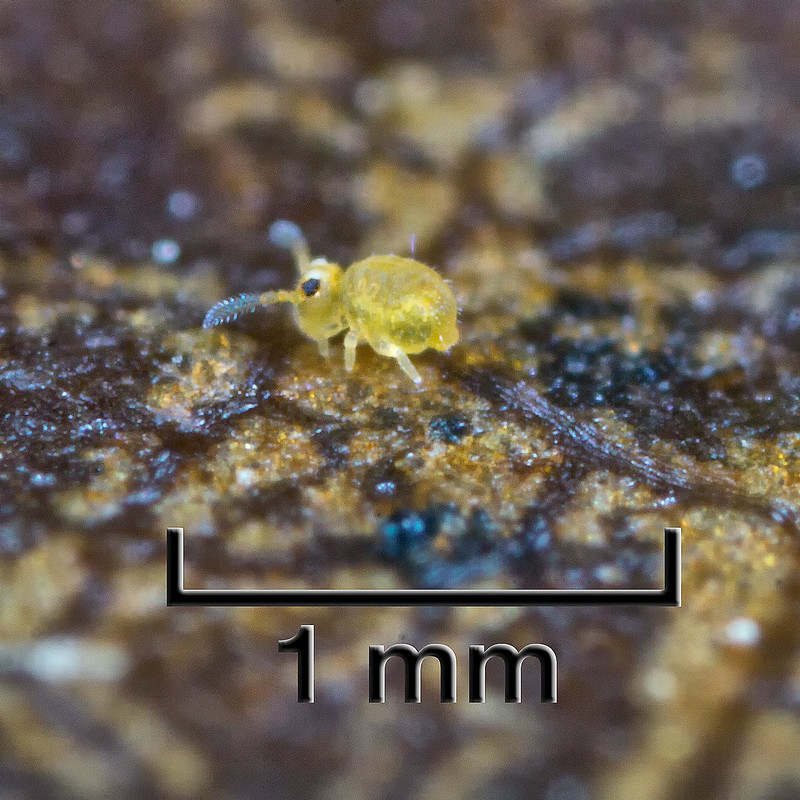
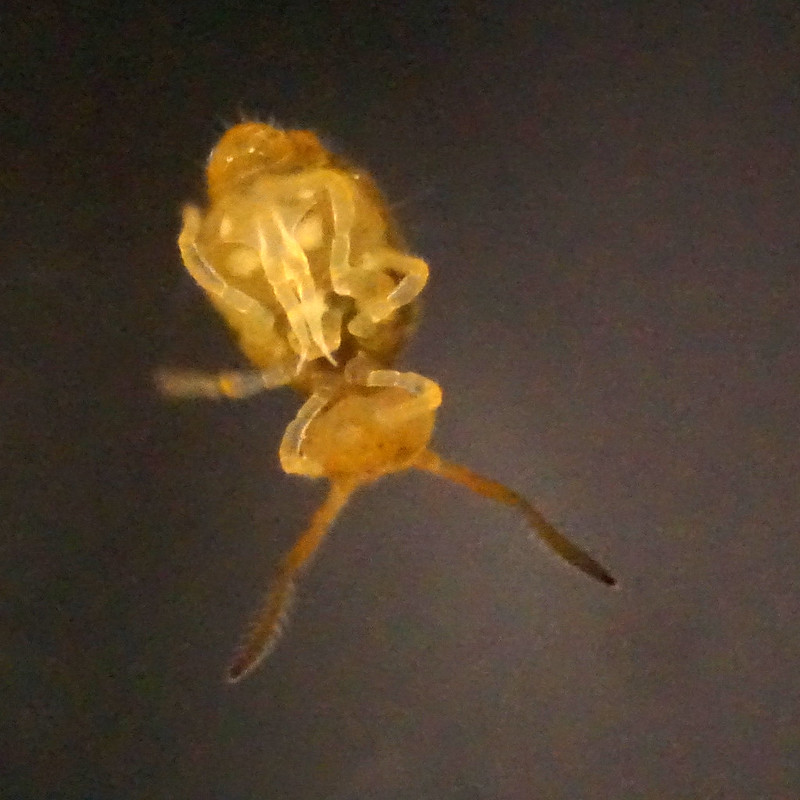
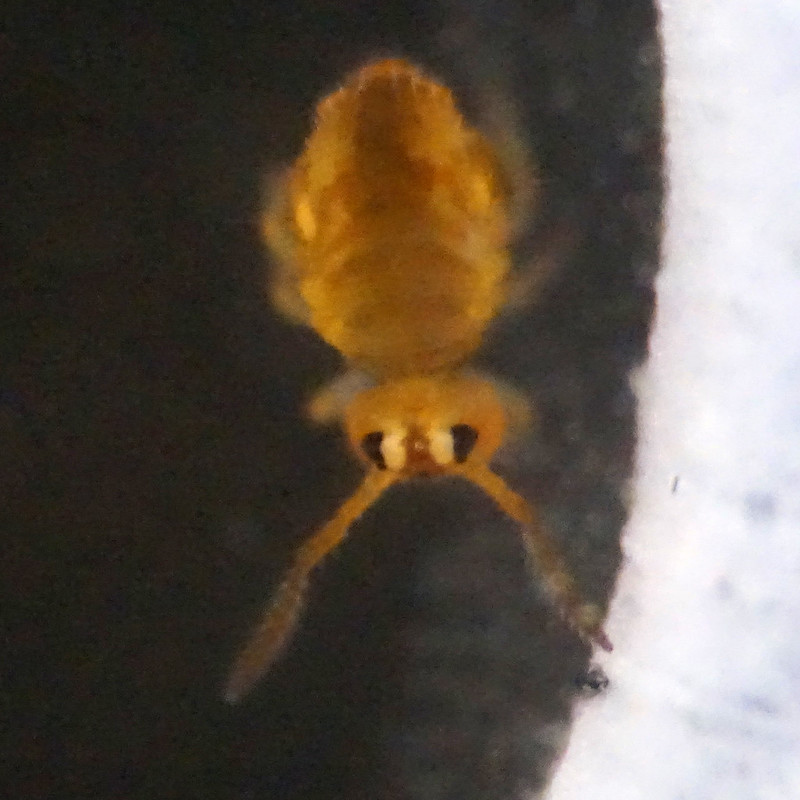
Sminthurinus aureus is a very common terrestrial springtail, less than 1mm long. It is particularly abundant on the underside of fallen leaves in autumn (as are other globular species). As the names suggests, it has an overall golden colour with no clear banding. Sminthurinus aureus has the 'small abdomen' (the animal's "tail end") wholly fused, while other UK Sminthurinus have a visible division between segments 5 and 6. The fourth antennal segment (ant4) is not subdivided.

Sminthurinus aureus

Female:
Sminthurinus aureus

Sminthurinus aureus

S. aureus comes in a variety of colour forms with varying degrees of dark pigment, e.g. form ochropus:
Sminthurinus aureus form ochropus


The entire Sminthurinus aureus group badly needs a taxonomic revision. A good example of this is Sminthurinus reticulatus. Although very similar to S. aureus,S. reticulatus is distinctively patterned with 3-4 transverse bands on the dorsal abdomen plus dark lateral bands which are discontinuous around the posterior end of the abdomen:

Sminthurinus reticulatus

However, there is some confusion about the "true" Sminthurinus reticulatus (which DNA evidence supports as a separate species), and Sminthurinus aureus form reticulatus. The differences are said to be:

Sminthurinus reticulatus: transverse abdominal bands are the same dark colour as the lateral bands.
Sminthurinus aureus form reticulatus: transverse abdominal bands are paler than the lateral bands.

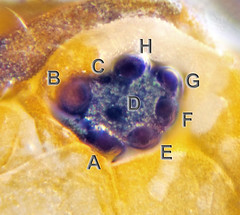
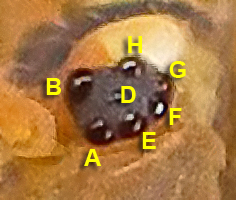
There are also reports about differences in the arrangement of the ocelli on the eyespot:

Sminthurinus aureus group (including form reticulatus): Ocelli C and D are distinctly smaller than the others (ABcdEFGH):
Sminthurinus aureus group ocelli

Sminthurinus reticulatus: Ocellus C is absent (ABdEFGH):
Ocelli

I have not yet been able to confirm this by observations.


Sminthurinus elegans form ornatus
Small (to 1mm) golden springtail with characteristic patter of four dark longitudinal bands on the abdomen - in this form the typical midstripe of S. elegans is lacking. Found in leaf litter and low vegetation in almost all terrestrial habitats, preferring drier areas than S. aureus.


Sminthurus viridis is a relatively large greenish or yellowish brown springtail reaching 3mm in length. The fourth antennal segment (ant4) is divided into 18 subsegments:


There are two variants of this species. Sminthurus viridis ssp. cinereoviridis has two spots on small abdomen:


In the ecovariant nigromaculatus of S. viridis, three spots are present: https://www.collembola.org/images/stach/1956/Sminthurus-viridis-1956-J-Stach-Poland-PlateXXXII-Fig3.jpg There are supposedly difference in chaetotaxy of the setae on the subcoxa of the third leg, but I have found it impossible to image these. Steve Hopkins was reluctant to accept nigromaculatus as a separate species. As a dyed-in-the-wool taxonomic lumper, I wouldn't disagree. Frans Janssens calls it "Sminthurus viridis ecovariant nigromaculatus", which is said to be associated with sandy areas, heathland, moors, heather, etc.


Sunday, 22 April 2018

Sminthurinus aureus

Sminthurinus aureus is a very common terrestrial springtail, less than 1mm long. It is particularly abundant on the underside of fallen leaves in autumn (as are other globular species). As the names suggests, it has an overall golden colour with no clear banding. Sminthurinus aureus has the 'small abdomen' (the animal's "tail end") wholly fused, while other UK Sminthurinus have a visible division between segments 5 and 6. The fourth antennal segment (ant4) is not subdivided.

Sminthurinus aureus

Female:
Sminthurinus aureus

Sminthurinus aureus

S. aureus comes in a variety of colour forms with varying degrees of dark pigment, e.g. form ochropus:
Sminthurinus aureus form ochropus