Showing posts with label Isotoma. Show all posts
Showing posts with label Isotoma. Show all posts
Thursday, 30 April 2020

Saturday, 14 March 2020
A cautionary tale

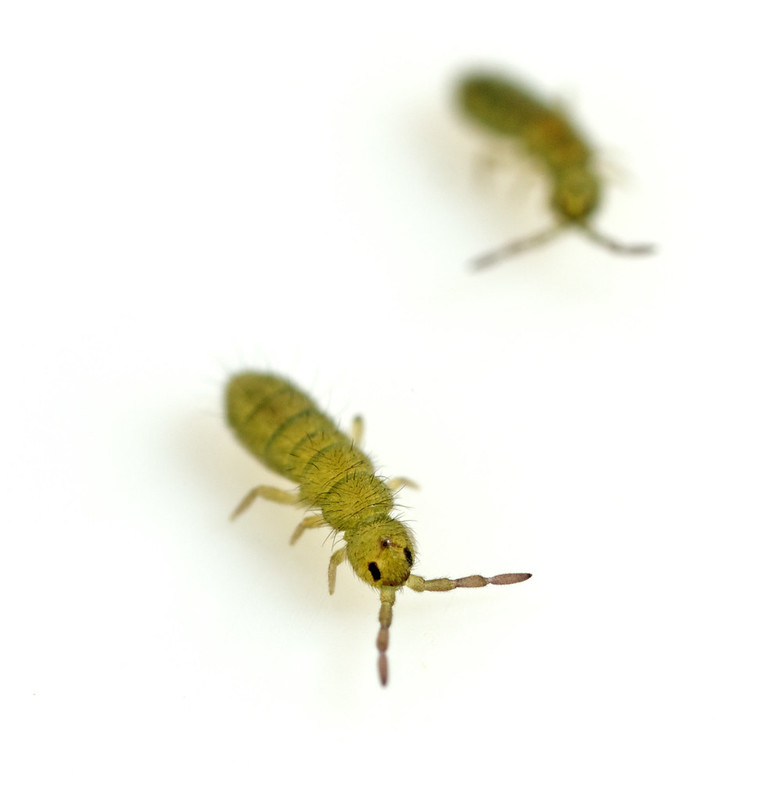
For those who think they can tell Isotoma viridis from other Isotoma by the colour alone - two Isotoma viridis specimens from the same sample, one green, one not, confirmed by the manubrial teeth.
Monday, 11 November 2019
Isotoma viridis

In spite of all the rain and good numbers of springtails over the last few weeks (dominated by Dicyrtomina saundersi), Isotomids have been largely missing. However, the recent haul of leaf litter had good number of Isotoma viridis, a species I have not seen since last winter.

Monday, 11 February 2019
Alcohol Hand Gel Mounts
This is in no way original, but I want to document use of alcohol hand gel as a temporary mounting method for springtails. Alcohol hand gel is readily available in supermarkets and chemists. There are many different brands but choose a colourless one containing 70% alcohol (which although not stated, I think is isopropanol?). You probably won't be able to find a brand without perfume, so you're going to smell nice (?) after using it! Buy the cheapest you can find (always a guiding principle). The full list of ingredients of the one I use is: alcohol (isopropanol?), water, glycerin, acrylates/alkyl acrylate crosspolymer, perfume, triethanolamine, aloe barbadensis extract, phenoxyethanol. There's a lot of other stuff in there in addition to the alcohol, but the extra gloop turns out to be useful. Put a springtail (or other small insect) on a clean microscope slide and put a drop of the gel on top, then a coverslip. The gel and the coverslip allows you to roll the specimen around to see the features you want - an advantage of the gel consistency. I am able to get very good resolution of specimens mounted in this way, including being able to resolve manubrial teeth and macrosetate insertion points, something I have not been able to resolve using other methods. I have also taken specimens from the gel and then cleared them or put them back into 70% alcohol for storage without any problems, so I would definitely recommend a bottle of hand gel in your springtail kit. I have tested whether sealing the edges of the mount with clear nail varnish can be used to make permanent or semi-permanent mounts. This seems to work for 24-48 hours but after that the specimen deteriorates and after a week at room temperature the gel has gone cloudy and the specimen is mush, so these are really temporary mounts. Examples:
Isotoma viridis in alcohol hand gel:
Click for larger image
Heteromurus nitidus in alcohol hand gel:
Click for larger image
Isotoma viridis in alcohol hand gel:
Click for larger image
Heteromurus nitidus in alcohol hand gel:
Click for larger image
Friday, 18 January 2019
Isotoma are like busses
You wait ages for Isotoma anglicana to come along and then, when you're desperate to find some Isotoma viridis so you can make comparison images of the manubrial teeth, it's anglicana all the way down...
What do these manubrial teeth do? They hook onto the teeth on the rami of the hamula or retinaculum, a catch-like structure which holds the springloaded furca in place under the body. In most other species of Collembola the retinacular teeth hook onto ridges at the inner base of the dentes. Since this is a lock and key type mechanism, the shape and arrangement of teeth varies from one species to another.
Saturday, 12 January 2019
Family Isotomidae
Isotomid characteristics:
Ocelli:

Desoria - covered in short setae (hairs); ocelli B-D-E in straight line; mucro has four teeth but does not possess a lateral seta, apical tooth is large (c.f. Isotomurus); no teeth on manubrium (c.f. Isotoma); Hopkin key #224
Isotoma - long macrosetae on all body segments; ocelli C-D-E in straight line; mucro has three teeth; bothriotricha absent; Hopkin key #220
Isotomurus - long macrosetae on abd4-6 only; ocelli B-D-E in straight line; mucro has four teeth, apical tooth smaller than the others (c.f. Desoria); bothriotricha present; Hopkin key #209 (pigmentation patterns).
Vertagopus - no long macrosetae but a fuzzy cover of short setae; mucro has four teeth; tibiotarsi (adjacent to claws) have clavate tenant (knobbed) setae; only two British species; Hopkin key #215
- unscaled
- elongated body and body segments of approximately equal length (c.f. Entomobryidae, abd4 more than twice as long as abd3)
- antennae with 4 segments of similar length
- 8+8 ocelli
- furca & PAO present
- no anal spines
Ocelli:
Desoria - covered in short setae (hairs); ocelli B-D-E in straight line; mucro has four teeth but does not possess a lateral seta, apical tooth is large (c.f. Isotomurus); no teeth on manubrium (c.f. Isotoma); Hopkin key #224
Isotoma - long macrosetae on all body segments; ocelli C-D-E in straight line; mucro has three teeth; bothriotricha absent; Hopkin key #220
Isotomurus - long macrosetae on abd4-6 only; ocelli B-D-E in straight line; mucro has four teeth, apical tooth smaller than the others (c.f. Desoria); bothriotricha present; Hopkin key #209 (pigmentation patterns).
Vertagopus - no long macrosetae but a fuzzy cover of short setae; mucro has four teeth; tibiotarsi (adjacent to claws) have clavate tenant (knobbed) setae; only two British species; Hopkin key #215
Saturday, 5 January 2019
Isotoma
Genus Isotoma (Hopkin key #220) has:
Isotoma caerulea - Widespread but under-reported, records are confused with I. anglicana.
Isotoma riparia - Apparently scarce, only at edge of rivers, probably under-reported.
Isotoma viridis - Common, widespread, records are confused with I. anglicana/caerulea.
Burkhardt, U., & Filser, J. (2005) Molecular evidence for a fourth species within the Isotoma viridis group (Insecta, Collembola). Zoologica scripta, 34(2), 177-185: "For identification of single species within the Isotoma viridis group, we present polymerase chain reaction–restriction fragment length polymorphism (PCR–RFLP) as a fast and efficient DNA‐based molecular method. We used five PCR primers amplifying the cytochrome oxidase II (COII) region (760 bp) of the mitochondrial DNA. The sequences clearly separated four species (I. viridis, I. riparia, I. anglicana and I. caerulea) out of samples from Norway, Sweden, Germany and Switzerland. Examination of genetic variation and phylogenetic relationship did not support the separation of two colour pattern forms of I. viridis into distinct species."
The species Isotoma anglicana/caerulea/viridis are troublesome and have been hugely confused. Contrary to what has sometimes been claimed it is not possible to distinguish between Isotoma anglicana/caerulea/viridis by habitus (general appearance - especially colour), they can only be reliably separated by microscopic examination of the manubrial 'teeth' and chaetotaxy of the dens (see below):
- Isotoma anglicana and Isotoma caerulea have two pairs of manubrial teeth on each side of the thickened apical edge of the manubrium.
- Isotoma viridis has a single pair of manubrial teeth.
Isotoma anglicana:
Isotoma viridis
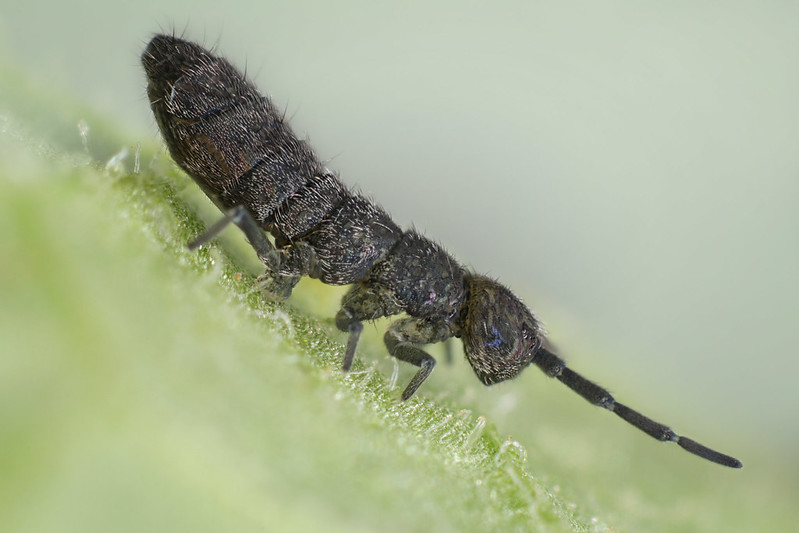
Colour is highly variable, from yellow to almost black (possibly becoming darker with age). Juvenile:
- Ocelli C-D-E aligned (= Isotoma)
- One pair of manubrial teeth
Isotoma caerulea
Small specimens are usually green, becoming more blue in large specimens. Two pairs of manubrial teeth:


The key feature which separates Isotoma anglicana/caerulea is the chaetotaxy (arrangement of bristles (setae)) on the furca (see https://www.collembola.org/publicat/isotoma.pdf). Arne Fjellberg identified two differences:
a) The macrosetae at dorsal (anterior) side of dens, near the base: I. caerulea has two, I. anglicana has three. In practice, the dens is a forest of setae from which it is difficult to pick out individual hairs:

b) The macrosetae at dorsal side of manubrium. These macrosetae are also present in juveniles – even the first instar - and are often more easily observed in them. In Isotoma anglicana, the forward bristle A is longer and thicker than the rear bristle, B; in I. caerulea this is reversed:
I. anglicana = A > B
I. caerulea = A < B
Juveniles:
Adult (Photo Marie Huskens):
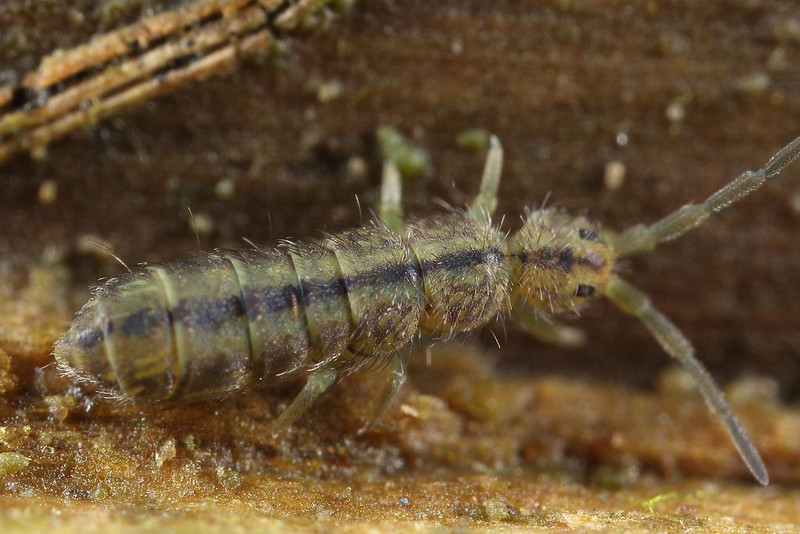
Isotoma riparia has a distinctive stripe down the middle of the body similar to Isotomurus palustris (which has more distinct lateral bands and no dark pigment between the eyes) but without trichobothria. Juveniles are a yellow colour similar to Isotomurus plumosus. One manubrial tooth. Only occurs in very wet habitats and has a distinctive stripe down the middle of the body - much like Isotomurus palustris, but without trichobothria. Photo Jan van Duinen:
- long macrosetae on all body segments
- ocelli CDE in straight line
- mucro with three teeth
- bothriotricha absent
Isotoma caerulea - Widespread but under-reported, records are confused with I. anglicana.
Isotoma riparia - Apparently scarce, only at edge of rivers, probably under-reported.
Isotoma viridis - Common, widespread, records are confused with I. anglicana/caerulea.
Burkhardt, U., & Filser, J. (2005) Molecular evidence for a fourth species within the Isotoma viridis group (Insecta, Collembola). Zoologica scripta, 34(2), 177-185: "For identification of single species within the Isotoma viridis group, we present polymerase chain reaction–restriction fragment length polymorphism (PCR–RFLP) as a fast and efficient DNA‐based molecular method. We used five PCR primers amplifying the cytochrome oxidase II (COII) region (760 bp) of the mitochondrial DNA. The sequences clearly separated four species (I. viridis, I. riparia, I. anglicana and I. caerulea) out of samples from Norway, Sweden, Germany and Switzerland. Examination of genetic variation and phylogenetic relationship did not support the separation of two colour pattern forms of I. viridis into distinct species."
The species Isotoma anglicana/caerulea/viridis are troublesome and have been hugely confused. Contrary to what has sometimes been claimed it is not possible to distinguish between Isotoma anglicana/caerulea/viridis by habitus (general appearance - especially colour), they can only be reliably separated by microscopic examination of the manubrial 'teeth' and chaetotaxy of the dens (see below):
- Isotoma anglicana and Isotoma caerulea have two pairs of manubrial teeth on each side of the thickened apical edge of the manubrium.
- Isotoma viridis has a single pair of manubrial teeth.
Isotoma anglicana:
Isotoma viridis
Colour is highly variable, from yellow to almost black (possibly becoming darker with age). Juvenile:
- Ocelli C-D-E aligned (= Isotoma)
- One pair of manubrial teeth
Isotoma caerulea
Small specimens are usually green, becoming more blue in large specimens. Two pairs of manubrial teeth:


The key feature which separates Isotoma anglicana/caerulea is the chaetotaxy (arrangement of bristles (setae)) on the furca (see https://www.collembola.org/publicat/isotoma.pdf). Arne Fjellberg identified two differences:
a) The macrosetae at dorsal (anterior) side of dens, near the base: I. caerulea has two, I. anglicana has three. In practice, the dens is a forest of setae from which it is difficult to pick out individual hairs:

b) The macrosetae at dorsal side of manubrium. These macrosetae are also present in juveniles – even the first instar - and are often more easily observed in them. In Isotoma anglicana, the forward bristle A is longer and thicker than the rear bristle, B; in I. caerulea this is reversed:
I. anglicana = A > B
I. caerulea = A < B
Juveniles:
Adult (Photo Marie Huskens):
Isotoma riparia has a distinctive stripe down the middle of the body similar to Isotomurus palustris (which has more distinct lateral bands and no dark pigment between the eyes) but without trichobothria. Juveniles are a yellow colour similar to Isotomurus plumosus. One manubrial tooth. Only occurs in very wet habitats and has a distinctive stripe down the middle of the body - much like Isotomurus palustris, but without trichobothria. Photo Jan van Duinen:
Monday, 5 March 2018
Isotoma viridis
Desoria - covered in short setae (hairs)
Isotoma - long setae on all body segments
Isotomurus - long setae on abd5+6 only
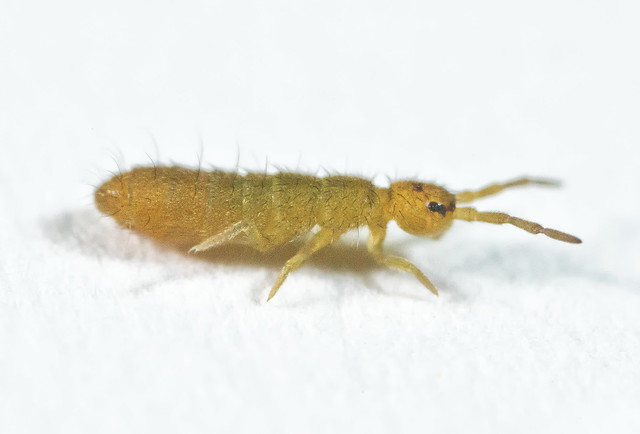
Isotoma viridis: Green pigment (variable):
Isotoma = Ocelli CDE in a straight line, Abd5 & 6 separate:
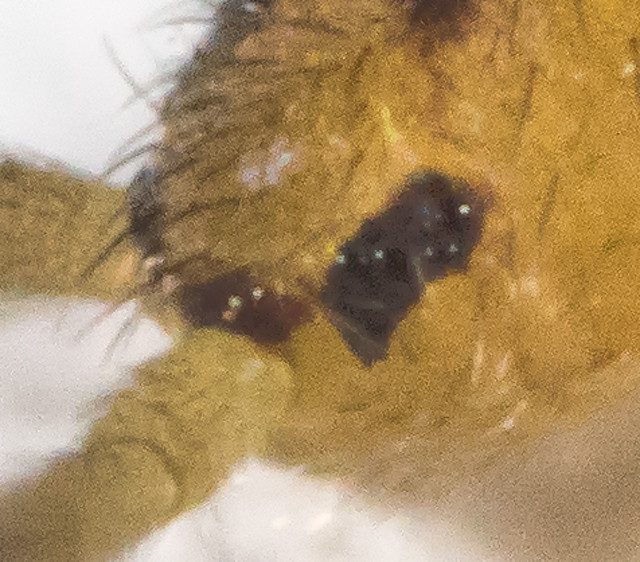
Single pair of 'teeth' on the thickened apical edge of the manubrium (c.f. 2 pairs = I. anglicana):
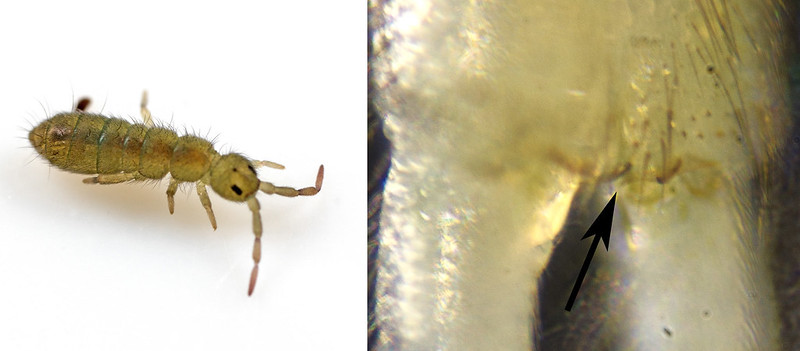
Isotoma - long setae on all body segments
Isotomurus - long setae on abd5+6 only
Isotoma viridis: Green pigment (variable):
Isotoma = Ocelli CDE in a straight line, Abd5 & 6 separate:
Single pair of 'teeth' on the thickened apical edge of the manubrium (c.f. 2 pairs = I. anglicana):
Subscribe to:
Posts (Atom)