Tuesday, 7 May 2019

17.04.19 - Croft Pasture

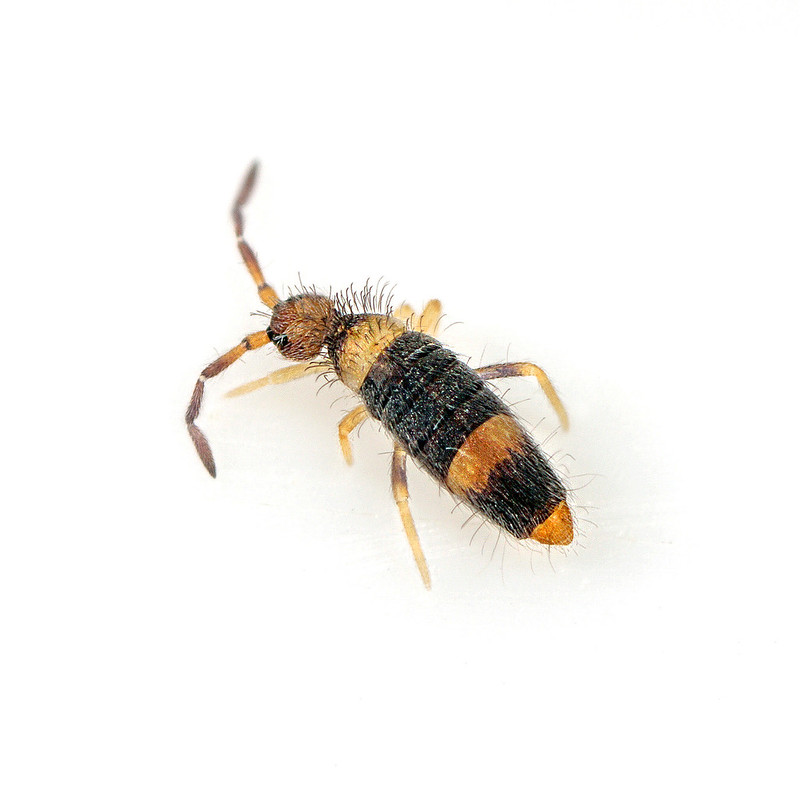
Deuterosminthurus pallipes


With the dry conditions I headed for the water meadows at Croft desperate to find moisture (and springtails). Both were in short supply but I found a few Entomobrya nicoleti and Entomobrya nivalis. Most notable were the Deuterosminthurus pallipes - a sure sign that summer's here (even if the temperatures still feel like winter).

Wednesday, 1 May 2019

10.04.19 - Tilton Cutting

Springtails of Tilton

I visited Tilton Cutting because at times it's so wet that you can't really go there. However, the drought is really beginning to bite and finding any springtails at all was hard work. Eventually I managed to scrape together a short list: Entomobrya nivalis, Orchesella cincta, Pogonognathellus longicornis, Tomocerus minor.


Sunday, 21 April 2019

06.04.19 - Swadlincote

Springtails of Swadlincote

Clockwise: Entomobrya albocincta, Entomobrya nivalis, Vertagopus arboreus.


Not many springtails from the National Forest so we trekked up to Pick Triangle at Swadlincote to put some dots on the map. Unfortunately it turned out to be hard work because it was so dry. At Albert Village lake I managed to find one single specimen, a Tomocerus which I managed to lose. Across the road at Pick Triangle we did a little better beating vegetation, but this site needs another visit at a more suitable time of year.


Wednesday, 17 April 2019

30.03.19 - Pickworth Great Wood

Springtails of Pickworth
(not to scale)


We trekked all the way over to Pickworth for two reasons, first because it is a biologically rich area which is seriously under recorded, and second to put dots on the atlas - it's as far east as you can go without being in Lincolnshire. Indeed on entering the wood you can stand with one foot in VC55 and the other in VC53 (selfie temptation resisted). And on entering the wood virtually the first thing we saw was an Orange Underwing (Archiearis parthenias). The Lepidoptera were spectacular - by the end of the day though we'd seen dozens of Orange Undwerwings (I stopped counting at 20) plus too many Brimstone and Peacock butterflies to count, three Commas and two male Orange Tips. It was hot and sweaty and I got sunburnt because I had not adjusted my headgear from winter (wooly) to summer (floppy). However, butterfly weather is not springtail weather, and the dry, cracked soil put a crimp in springtails recording, although we found many of the usual suspects. Pickworth is on the list for return visits in more favourable conditions.

Wednesday, 10 April 2019

Reservoir 13

Reservoir 13


There aren't many books about springtails around, and there are even fewer novels featuring springtails. Reservoir 13 by Jon McGregor is not only the best book I've read for a long time, it's also the only novel I've read where springtails get plenty of mentions. Are there any others?


Tuesday, 9 April 2019

27.03.17 - John O'Gaunt

I headed up to John O'Gaunt to do some recording because it was a big blank area on the VC55 Springtail Atlas. However I had two problems on this trip. The first was that this entire area is heavily agricultural with poor diversity, but the major problem was the lack of rainfall. At the end of March in what should be peak springtail season the soil was dry and cracked and springtails were hard to find. In the end I sampled as close to the water as possible in Gaddesby Brook (and also in a damp drainage ditch by the viaduct, where I found nothing). The banks of the brook turned up Entomobrya nicoleti, Entomobrya nivalis, Isotoma viridis and Orchesella cincta, but perhaps the most notable species were a number of Entomobrya albocincta, which seems to be quite prevalent at the moment and is normally less abundant:

Entomobrya albocincta

Saturday, 6 April 2019

24.03.19 - Ulverscroft

Ulverscroft is one of my favourite sites and although well recorded, because it was a nice spring day we opted for a wander though the woods. No surprises but a nice day out:

Springtails of Ulverscroft

Tuesday, 2 April 2019

20.03.19 - A bit of excitement at Thornton

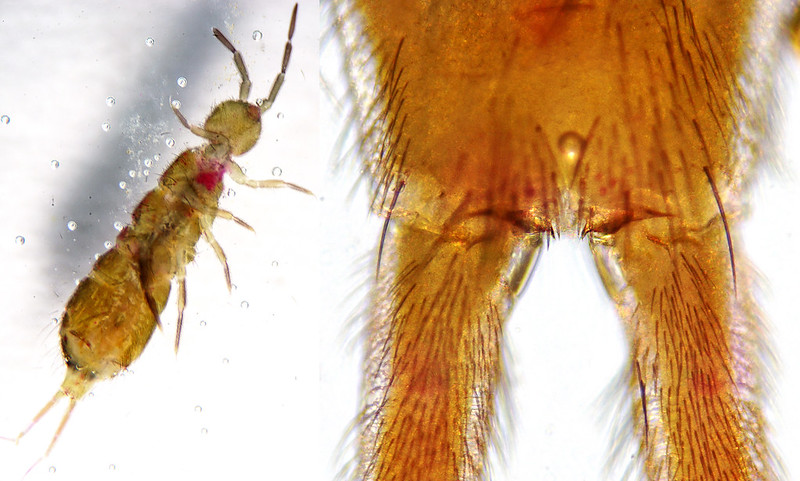
I received a tip-off that there was a big bloom of springtails at Thornton Reservoir. Because of the low rainfall over the winter water levels were very low and springtail numbers had exploded on the exposed mud. Unfortunately I was not able to get there quickly, and the following week was mostly gales, falling trees and torrential rain so by the time I did get on site the water level had risen several feet and most of the mud was underwater. However, there were still good numbers of Isotomids under rock by the waterline. These turned out to be Isotomurus palustris sensu lato - near continuous dorsal line and fainter lines on the sides of the abdomen (juveniles paler); mucro with four teeth, apical tooth smaller than the others and no lateral seta:

Isotomurus palustris sensu lato


Also present were large numbers of Paranchus albipes. This is an interesting beetle which is very much a water line specialist, following the water level up and down. It's also one of the specialist springtail predators, numbers having exploded based on the food supply:

Paranchus albipes


Because it was a nice day I took a walk around the reservoir and sampled under the bark of a Scots Pine as well as from Ivy growing up trunk because this was a good contrast to the mad at the waterline at the other end of the reservoir. Nothing surprising here, lots of Entomobrya nivalis, but also probably more Entomobrya albocincta than I have seen in a sample:

Entomobrya albocincta

Entomobrya nivalis
Entomobrya nivalis


Sunday, 31 March 2019

PlaqSearch

PlaqSearch

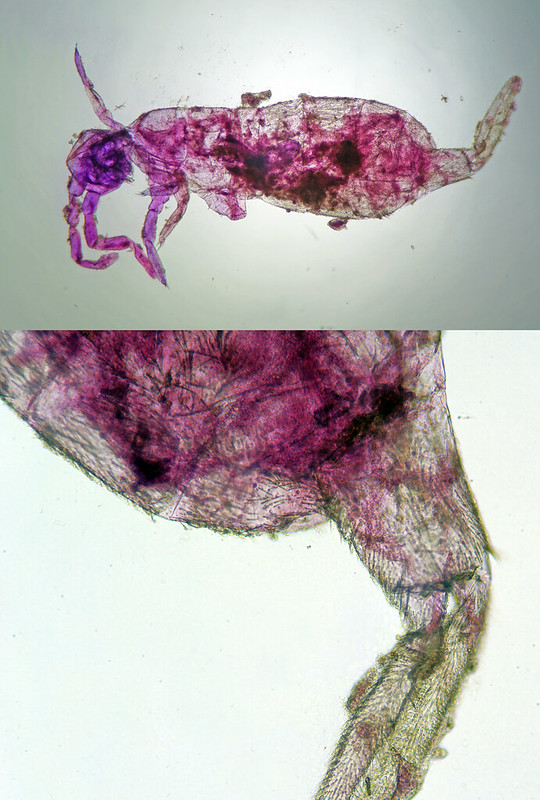
A few years ago when I was pretending to be a mycologist I became aware that the community was using PlaqSearch (Google it: stated ingredients: Fd and C Blue No 1, D and C Red No 28, Dextrates, Magnesium Sterate, Sodium Starch Glycolate) for differential staining of fungi. This is designed to show if you have dental plaque so it is safe to use as it is intended for oral use. In fungi, some tissues stain blue and others pink. I still have a bottle of this kicking around in my microscope kit and every time I make slides I think "I should try it on springtails". And so I did.

My first attempt was on Isotoma viridis preserved in 70% alcohol - a 5 minute stain, destain in water and mount. The results were underwhelming, just a few random pink patches resulting from inefficient destaining I think. In retrospect, since PlaqSearch is water-based this was predictable because of the hydrophobic nature of the Collembolan cuticle:

Stained with PlaqSearch

I had another go, this time with a cleared specimen:

Cleared & Stained with PlaqSearch

Nothing really of interest, so I conclude that PlaqSearch doesn't offer anything of interest to the Collembologist (if that's a word).